

Most advice about septic odor starts with causes. That is the wrong end. The useful question is not “why does it smell” but “where exactly do you smell it”, because the location tells you which part of the system to look at, and in several cases it tells you the septic system is not the problem at all.
Sara Heger, of the University of Minnesota’s Onsite Sewage Treatment Program, puts the principle plainly in her guidance on outdoor septic odor: to troubleshoot these odors, it helps to identify where the odor is originating from. Odor does not establish gas concentration or prove that an area is safe; keep clear of tank openings and suspected wastewater.
Observe from a safe distance; do not approach openings or suspected sewage to sniff for gas. Record where the odor is noticeable: inside the house, in the yard generally, at the treatment unit, at a tank lid, at the pump tank, or over the spray field? Each one points somewhere different.
Start here: where do you smell it?
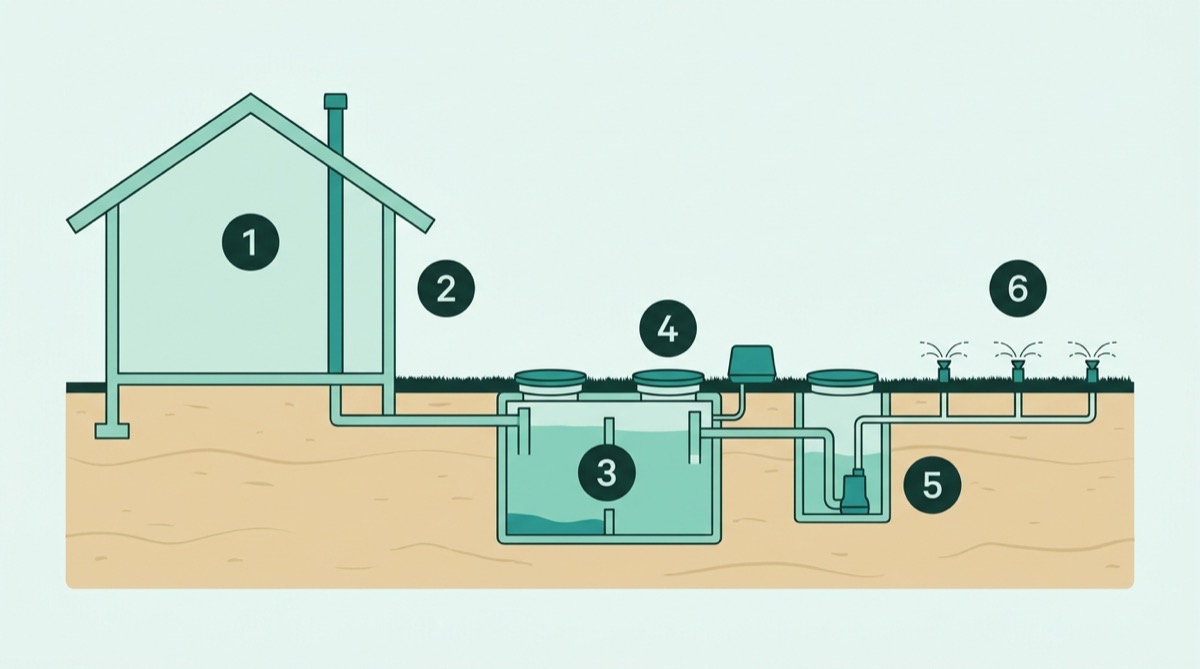
| Where you smell it | What it often points to | What you can do | Who to call |
|---|---|---|---|
| Inside the house | Often plumbing: a dry drain trap, a failed toilet seal or a vent problem | Run water down rarely used drains for a minute | A plumber, if the smell stays |
| Across the whole yard | How the system vents, combined with wind and the shape of the land | Note when it happens and which way the wind blows | Ask a plumber or your provider about the vent |
| At the treatment unit | The system may not be working properly | Listen from outside to confirm the air pump is running | Your provider. A lasting smell here is a symptom |
| At one tank lid | A worn or leaking lid seal | Check from outside that the lid is in place. Do not open it | Your provider |
| At the pump or dosing tank | The lid seal, or gas escaping through the wiring conduit | Check from outside that the lid is secure | Your provider, to check the seals |
| Over the spray field | Possible surfacing wastewater, which is a health risk | Keep people and pets off and note any wet or spongy ground | Your provider, now |
The sections below explain each one.
Inside the house: usually not your septic system
An indoor sewer smell is often a plumbing problem rather than a treatment problem. Every drain has a trap holding a small water seal that blocks gas from coming back up. When that water evaporates, the seal is gone and the path is open.
The classic case is a bathroom that smells after a holiday, a spare shower nobody uses, or a floor drain in a basement or garage. Running water down every drain in the house for a minute refills the traps, and the smell often goes with it. If the smell stops, a dry trap may explain that odor; this does not establish the condition of the septic system.
If an indoor odor persists after that, the candidates are a failed toilet seal, a damaged or blocked plumbing vent, or a broken drain line — all plumbing work, not septic work. Heger notes that if building sewer lines are clogged or holding wastewater, tank gases cannot vent the way they are supposed to, which is a case where a plumbing fault produces a septic-smelling result.
In the yard generally: venting and wind
If the whole yard smells rather than one spot, the cause is often how and where the system vents, combined with the shape of the land.
Most septic tanks are designed to vent back through the building’s plumbing vent and out the roof. Heger explains that where a yard in general smells of septic or sewer gas, the plumbing vent pipe on the structure — or on a neighbour’s structure — may need extending to diffuse the odors. Properties in valleys, in forested areas or in low ground may not have wind patterns that carry gases away: as wind blows over the house, air currents that should lift the gases up and away can instead push them down into the yard.
Two remedies she describes, with an important caution on the second:
- Extending the vent pipe, so odors disperse higher and further from where you sit.
- A carbon filter on top of the vent. These need changing regularly, typically annually, to stay effective, and they must not obstruct airflow. In cold climates they can collect moisture in winter and freeze, which causes septic odors inside the building — so they are normally removed for the cold season.
That last detail is the kind of thing that turns a fix into a new problem, and it is worth knowing before you buy one.
At the treatment unit: the one that matters most for aerobic owners
This is where an aerobic system differs from a conventional one, and the standard is higher than people expect.
Heger is unambiguous about pretreatment devices, a category that includes aerobic treatment units: if a septic odor is persistent around one of these units, the system may not be performing properly, and the manufacturer or designer should be contacted. There should not be septic odor around these units when they are performing properly.
Read that again if you own one. A persistent smell at your treatment unit is not something to live with or mask. It is a symptom.
One reason an aerobic unit can start smelling is that it has stopped being aerobic. Oklahoma State University Extension advises owners to check for foul odor often, and notes that a rotten-egg smell can indicate the system is not working properly. When the air supply fails, the biology in the aeration chamber shifts, and the odor follows. Before calling anyone, do the thirty-second check in our guide to an aerobic septic air pump that is not working: stand at the pump housing and confirm you can hear it running.
Other causes, such as overloading or an upset microbial population, are for your service provider to diagnose. At the unit itself, your job is to notice and report, not to adjust.
One cause is worth checking yourself because it is free: how much water went in recently. Oklahoma State University Extension warns that microorganisms in the aeration tank need to be fed constantly and will not thrive where the food supply is very low, as at a seasonal property or vacation home, and that washing a dozen loads of laundry immediately after returning from a holiday can wash out what population is left. If your smell started after a month away or after a houseful of guests, say so when you call. Our guide on how much water an aerobic system can handle covers the loading side.
At a tank lid or access point
If the smell is sharply localised to a lid, the seal is the suspect. Heger’s guidance covers the detail:
- Plastic lids typically have a rubber seal that keeps odors in the tank, and these degrade over time and need replacement.
- A leaking concrete lid can be sealed temporarily with weather stripping or similar, which contains odor while still allowing access for maintenance — and that seal has to be replaced after each service visit.
- A thin layer of mulch over a lid absorbs some odor, but the lid must not be covered with soil, because the tank is maintained by having access at grade.
- Inspection pipes, typically four to six inches across, should have tight-fitting covers; damaged ones release gas.
Burying a lid to stop a smell is an expensive mistake. It converts a seal problem into an excavation at the next service visit.
At the pump or dosing tank
Check that the maintenance access lid is secure and properly sealed, as above. Ask the qualified provider to assess whether wiring and conduit penetrations are correctly sealed, so septic gas is not escaping through it. A conduit is a pipe, and a pipe with an open end vents.
Over the spray field or soil treatment area
This is the one to treat seriously rather than as a nuisance.
Strong odor over the soil treatment area can indicate a problem with that part of the system. Heger’s instruction is to check all inspection pipes for breakage and secure caps, and to walk the whole area looking for wet or spongy ground indicating sewage surfacing. If you find that, she is explicit: people and animals can come into contact with sewage, this is considered a public health threat, and it must be corrected immediately.
Do not try to fix surfacing effluent yourself. Keep children and pets off the area, call your maintenance provider, and if the surfacing is significant, call your permitting authority too. Our guide on aerobic septic red flags explains why wet spots are taken so seriously.
Three things not to do
Do not pour in an additive. Heger states that septic additives are not recommended to reduce odor: there is no independent research verifying their effectiveness, and there is a risk of upsetting the natural activity in the system. A bottle that promises to end odors is selling you the possibility of a second problem.
Do not seal or cap a vent. Vents exist so gases leave in a controlled place. Blocking one does not remove the gas; it finds another route, often into the building.
Do not add extra chlorine to mask a smell. Chlorination disinfects effluent at a specific point in the process; it is not an air freshener, and over-dosing creates its own hazards. Our guide to chlorine tablets and the mistakes owners make covers why the product and the dose matter.
What to tell your provider
A good call is short and specific. Have these five answers ready.
- Where you smell it: inside, yard, treatment unit, a named lid, pump tank, or spray field.
- When it started, and whether it is constant or comes and goes with weather, wind or time of day.
- Whether the air pump is audibly running.
- What changed recently: a holiday, guests, heavy laundry, a power cut, heavy rain.
- Whether any ground is wet or spongy over the dispersal area.
Those five turn a vague complaint into something a technician can act on before arriving. Keeping them written down is easier with our free printable maintenance record and service call log.
Sources
- Sara Heger, University of Minnesota Onsite Sewage Treatment Program, Outdoor septic odor causes and solutions (25 March 2021), for odor at the yard, vent, lids, inspection pipes, pretreatment unit and soil treatment area.
- Oklahoma Cooperative Extension Service, PSS-2275, Aerobic Treatment System, for the advice to check for foul odor often and for the effect of seasonal use and post-vacation laundry on the aeration tank.
- University of Minnesota Onsite Sewage Treatment Program, Troubleshooting, for odors in a home typically indicating a plumbing problem, such as a dried-out floor-drain trap.
- U.S. Environmental Protection Agency, Types of Septic Systems, for the description of an aerobic treatment unit as a system injecting oxygen into the treatment tank to increase bacterial activity.
- Texas A&M AgriLife Extension, B-6234, “Living with an Aerobic Treatment Unit and Spray Field”, for the hazards associated with these systems, including poisonous or explosive gases, which is why odour investigation stops at the lid.
- Texas Commission on Environmental Quality, OSSF maintenance guidance, for the Texas maintenance contract with a licensed maintenance provider, who inspects the system’s components at each site visit; two years after installation, homeowners may maintain certain systems themselves instead, although some permitting authorities have stricter requirements.
Limits of this guide
Educational information only, and not a diagnosis of your system. Odor has many causes, some of which are plumbing rather than wastewater treatment, and the correct remedy depends on your equipment, your design and your local rules. Your system manual, your permit, your permitting authority and a qualified provider determine what is correct for your property. Sewage surfacing at ground level is a public health matter and should be reported, not managed privately.
Primary sources used: “Outdoor septic odor causes and solutions” by Sara Heger, University of Minnesota Onsite Sewage Treatment Program, published 25 March 2021; Oklahoma Cooperative Extension Service fact sheet PSS-2275, “Aerobic Treatment System,” by Sergio M. Abit Jr. and John William Jones (April 2017); and Texas A&M AgriLife Extension publication B-6234, “Living with an Aerobic Treatment Unit and Spray Field”.
Found something here that does not match your manual or your state’s rules? Tell us through our contact page and we will correct it.
Last reviewed: October 28, 2026.