
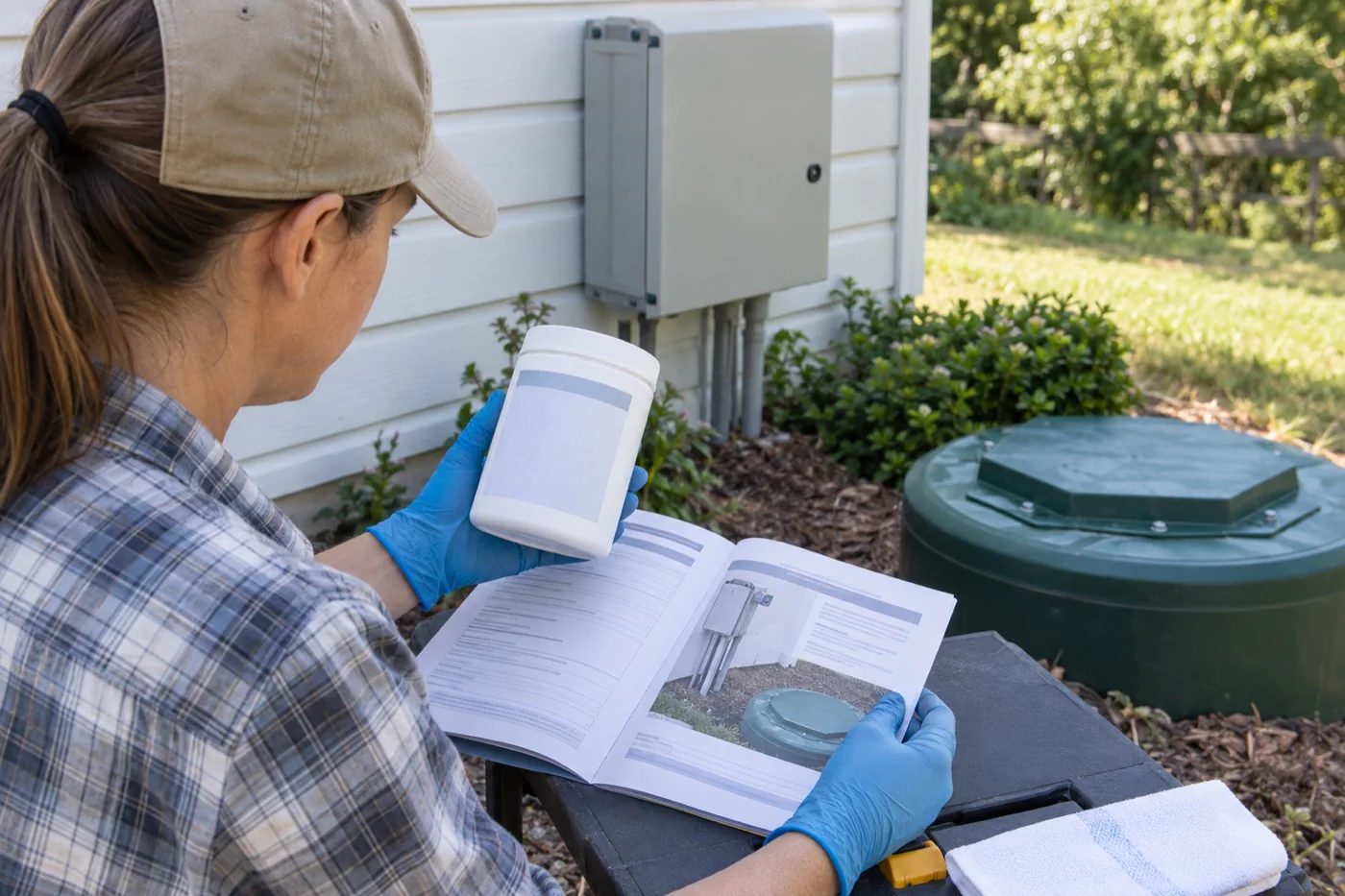
If your aerobic septic system has a tablet chlorinator, use the wastewater-disinfection product specified for that equipment. Swimming-pool tablets are not a substitute. Before buying supplies, confirm whether your system uses tablets, a liquid feed system, another disinfection method, or no separate disinfection stage.
This guide explains what to verify, what to record, and when to call your maintenance provider. It does not provide a universal chemical dose: the equipment instructions, product label, permit, and local requirements must determine that.
First identify the disinfection equipment
The words “aerobic septic system” describe a treatment process, not one identical package of equipment. Start with your owner’s manual and most recent service report. Look for the manufacturer, model, and any separate disinfection-unit documentation. A photo of an accessible equipment label can help your provider identify it without you opening a tank.
Ask the provider to write down the exact product name and where it belongs. Do not identify a chemical filling point by appearance alone. If you have just moved in and found an unmarked container of tablets, do not assume the previous owner purchased the correct product.
For an overview of the treatment stages, see our guide to aerobic septic system components.
Tablet or liquid chlorinator: which do you have?
Texas A&M AgriLife Extension describes two types of chlorinators used with aerobic systems: tablet chlorinators and liquid chlorinators. It also notes that some systems disinfect with ultraviolet light instead. A tablet chlorinator holds tablets in a tube so that the bottom tablet contacts the treated water and dissolves, and the next tablet moves down.
You can’t tell which type you have reliably from the outside. Check your owner’s manual, your latest service report, or ask your provider to write down the chlorinator type, make and model. Each type uses its own product: never put liquid bleach in a tablet feeder or tablets in a liquid system. If your system disinfects with ultraviolet light, it may not use chlorine at all; ask your provider to confirm before buying any product.
Can you use pool chlorine tablets?
No. Texas environmental regulator TCEQ specifically warns against swimming-pool tablets in aerobic wastewater systems. Its guidance identifies calcium hypochlorite tablets approved for wastewater disinfection and warns that pool tablets commonly contain a different chemical, trichloroisocyanuric acid. Incorrect products can create disinfection and chemical-reaction hazards. See TCEQ’s aerobic-system maintenance guidance.
Do not select a product just because an online listing says “chlorine,” “septic,” or “sanitizer.” Compare the actual label with the specification supplied for your chlorinator. A lower price is not a saving if the product is incompatible.
Where do chlorine tablets go?
Only into the chlorinator’s designated refill point, as shown in your equipment manual or by your provider, and only if refilling is an owner task under your contract. Never put tablets into any other lid, riser, cleanout or tank opening, and never open a tank or electrical equipment to look for the chlorinator. If you can’t identify the refill point with certainty, leave it to your provider.
Texas A&M AgriLife notes that although these tablets look like swimming-pool tablets, a system can use only tablets approved for wastewater disinfection.
Can you use liquid bleach instead?
A liquid-feed unit and a tablet feeder are different equipment arrangements. Do not pour bleach into a tablet feeder or drop tablets into a liquid reservoir. If your system uses liquid disinfection, obtain its own instructions from the manufacturer or maintenance provider, including the permitted product and concentration.
Do not attempt to convert between products by estimating equivalent chlorine strength. A change of disinfection method is a system-design question for a qualified provider and, where required, the permitting authority.
What to confirm before handling a product
Keep the following checklist with your service records. If any answer is missing, get clarification before refilling:
- Equipment: What is the chlorinator manufacturer and model?
- Product: Which exact labeled product and tablet size are specified?
- Responsibility: Does the maintenance agreement include replenishment, or is the owner responsible?
- Access: Which designated refill point may the owner safely use?
- Instructions: Where are the product label and equipment manual?
- Protection: What protective equipment does that label require?
- Monitoring: Who checks disinfection performance, and how is it documented?
Owner responsibility does not automatically mean the task is suitable for an untrained person. Request a demonstration from your provider if replenishment is an authorized owner task. Never enter a septic tank or open electrical equipment to investigate chemical-feed operation.
How many tablets should you add, and how often?
There is no tablet count or refill interval that this article can safely prescribe for every system. Obtain the instructions for your actual installation. Ask the provider to specify the checking interval, refill procedure, and signs that require service rather than more chemical.
Do not copy a neighbor’s schedule. Even similar-looking systems can have different equipment and operating conditions. Likewise, tablets remaining in a feeder do not by themselves prove that treated water meets the required disinfection standard.
A useful written instruction would identify your equipment and product, describe the permitted owner check, and explain when to contact the provider. “Add some every few weeks” leaves too much room for misunderstanding.
Keep a simple supply and service log
Record the date of each authorized check, the product used, any replenishment performed under the instructions, and unusual observations. Keep receipts or a photograph of the label so that the next service visit does not depend on memory.
Use a log with these columns: date, equipment or product reference, owner action, observation, and provider follow-up. Record a missed check honestly. Reliable records are more useful than an apparently perfect schedule.
If usage changes unexpectedly, tell the provider what changed and when. Do not respond by repeatedly increasing the amount. Put routine checks alongside your other tasks in the aerobic septic maintenance schedule.
Does an alarm mean the system needs chlorine?
Not necessarily. Do not interpret a red light or buzzer as a low-chlorine warning unless your control-panel documentation identifies it that way. Read the displayed message or indicator label from a safe position and give that information to your provider.
Adding tablets is not a general alarm remedy. Use our aerobic septic alarm guide to organize the information for a service call. Do not bypass an alarm, change control settings, or open treatment chambers to make the warning disappear.
Storage, spills, and accidental mixing
Follow the exact product label for storage, handling, first aid, and disposal. Texas A&M AgriLife warns that chlorine tablets release chlorine gas and advises not storing them in the house, garage or storage areas with metal tools. Keep the label available to anyone authorized to handle the product. Do not transfer tablets into an unlabeled household container or combine leftovers from different products.
If a container is damaged, its contents are unidentified, or chemicals have accidentally mixed, stop handling them and follow the product’s emergency instructions. Do not improvise a cleanup with another cleaner. For fumes, injury, or an immediate danger, move away from the exposure and contact the appropriate emergency service.
Questions to settle at the next service visit
Ask your provider to confirm the equipment and product in writing, explain how disinfection is checked, and clarify which supplies and visits your contract covers. Keep that answer with the manual rather than relying on a retailer’s product recommendation.
Correct supplies are only one part of maintenance. EPA notes that alternative systems with mechanical or electrical components need more frequent attention than conventional systems. Continue the inspection and servicing required for your installation; see EPA’s septic care guidance and your own permit.
Sources
- U.S. Environmental Protection Agency, How to Care for Your Septic System, for the instruction never to put household chemicals such as gasoline, oil, pesticides, antifreeze and paint thinner into a septic system, which is the same principle that rules out any product not labelled for the use.
- U.S. Environmental Protection Agency, Types of Septic Systems, for the role of disinfection in a system that discharges treated effluent to the surface.
- Texas A&M AgriLife Extension, B-6234, “Living with an Aerobic Treatment Unit and Spray Field”, for the hazards of handling chemicals around these systems and of the gases that can be generated, and for the two chlorinator types (tablet and liquid) and the storage warning about chlorine gas.
- Texas A&M AgriLife Extension, L-5303, “Spray distribution system”, for how a tablet chlorinator works and the rule that only tablets approved for wastewater disinfection can be used.
- Oklahoma Administrative Code, OAC 252:641-10-3, for a rule that requires the free chlorine residual of the effluent to be tested and recorded at least every six months where spray dispersal is used, which is the measurement that tells you whether your tablets are doing anything.
This is general homeowner education, not a chemical-handling procedure. Follow the product label, equipment instructions, permit, and qualified local advice.
Last reviewed: October 15, 2026.