
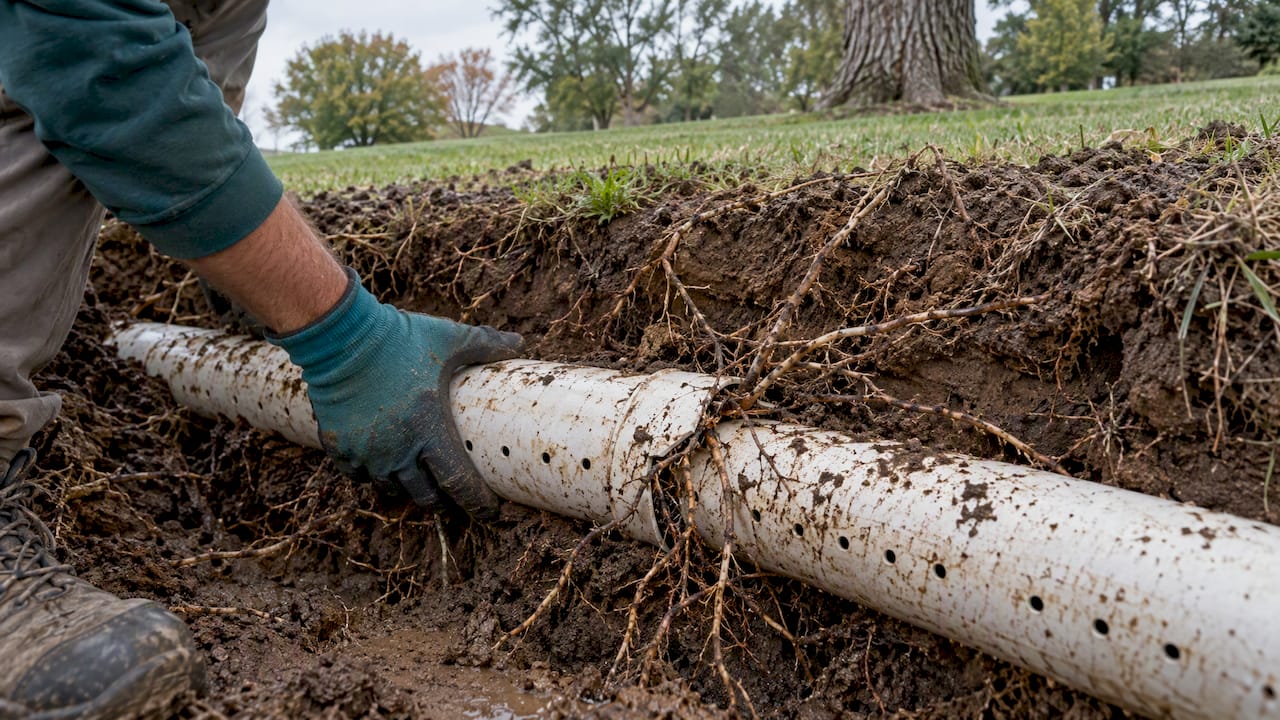
Tree roots commonly invade aerobic septic systems because the oxygen and moisture these systems release make them more attractive to roots than conventional tanks. If you notice slow drains, gurgling, sewage odor, or soggy patches near your tank or drainfield, stop heavy water use and call a licensed septic technician right away. Catching root intrusion early and preventing it through smart planting keeps repair costs manageable.
TL;DR:
- Roots are most attracted to aerobic systems because their active aeration and shallow trenches create moist, nutrient-rich zones near pipes and spray heads.
- Entry points for roots include unsealed pipe joints, cracked tanks or risers, and damaged drainfield trenches, especially if the system is old or poorly maintained.
- Symptoms such as slow drains, gurgling noises, persistent odors, soggy patches, or recurring clogs indicate potential root intrusion, confirmed through professional inspection techniques.
- Removal methods like mechanical clearing or chemical treatments provide temporary relief, but excavation and sealing of entry points are necessary for a permanent solution.
- Plant trees far enough away from the drainfield, favor shallow-rooted plants, and install root barriers to prevent future growth and reduce intrusion risks.
Table of Contents
- Why tree roots are drawn to aerobic treatment units
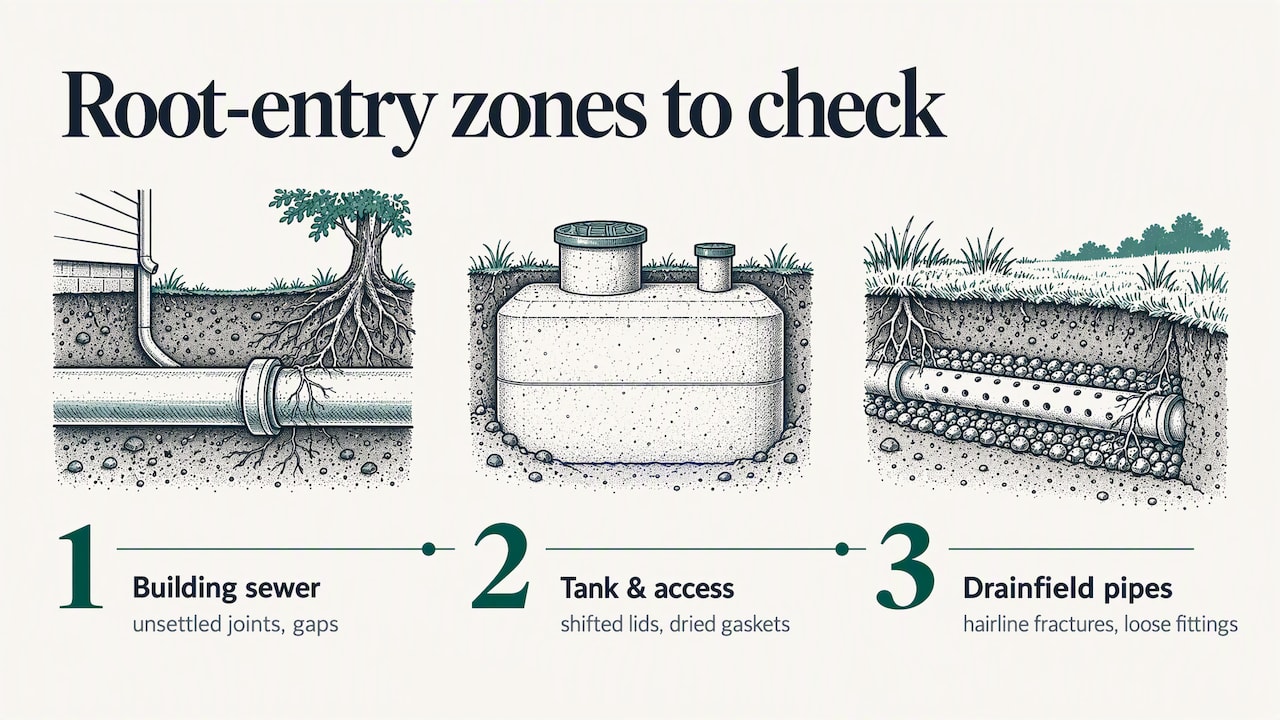
- Where roots enter: three zones worth checking
- Warning signs and how professionals diagnose root problems
- Removal and remediation: matching the fix to the damage
- Planting rules that keep roots away from your system
- A simple routine for catching root problems early
- Behind this guide: independent research for aerobic septic owners
- Weighing a tree’s value against your septic system’s health
- Put a maintenance routine in place before roots become a problem
- FAQ
- Sources
Why tree roots are drawn to aerobic treatment units
Aerobic systems work by pumping oxygen into wastewater to speed up decomposition, and that process creates exactly the conditions roots chase: warm, moist, nutrient-rich soil pockets near tanks, spray heads, and drip lines. Conventional anaerobic tanks sit sealed and mostly starved of oxygen, but aerobic treatment units, or ATUs, actively aerate their contents and often disperse treated effluent through spray nozzles or shallow drip fields. The Missouri Department of Health’s system owners manual notes that aerobic treatment units need more routine maintenance than conventional tanks and generate aerobic zones that roots find attractive when components are not sealed tight.
Certain features raise the risk further. Intermittent dispersal, where spray heads cycle on and off, creates the wet-dry gradient that root tips are especially good at tracking. Shallow trenches sit closer to the surface than many homeowners expect, putting them within easy reach of surface-rooting species. A high water table compounds the problem by keeping soil moist even between dosing cycles, giving roots a reason to linger near pipes instead of spreading elsewhere.
Site layout matters as much as biology. A cracked joint, a settled pipe, or a riser lid that no longer seals tightly gives roots a physical opening they would not otherwise find. Trees planted downhill from a drainfield, or directly above a trench, send roots toward the system simply because that is where the moisture gradient points. None of this means every yard with trees is doomed. It means the combination of an aerobic system’s chemistry and a few common installation weak points is what turns ordinary root growth into a plumbing problem.
Where roots enter: three zones worth checking
Root intrusion tends to concentrate in three distinct areas, and knowing which one is affected helps you describe the problem accurately to a technician.
The building sewer line, the pipe connecting your house to the tank, is often the oldest material on the property. Clay or cast iron sections and loosely fitted joints are classic entry points, since roots exploit any gap wider than a hair’s width. Industry reporting on infiltration problems points to unsettled joints and poor backfill as the primary vulnerabilities, more so than the pipe material itself, according to trade coverage of root and tank infiltration.
Tanks, pump chambers, and ATU access points are the second zone. Risers, lids, vent stacks, and the penetrations where pipes enter the tank wall are all potential gaps. A lid that has shifted slightly or a riser gasket that has dried out offers roots the same opportunity as a cracked pipe.
The drainfield itself, with its network of perforated distribution pipes, is the third and often hardest zone to inspect. Roots follow the oxygen and moisture these trenches release and, once they find a hairline fracture or a loose fitting, grow directly into the pipe interior, where they branch out and catch solids.
Warning signs and how professionals diagnose root problems
Several household symptoms point toward a developing root problem, though they can also signal unrelated septic issues, so pattern matters more than any single sign.
- Drains that empty slowly, especially in multiple fixtures at once, often mean a downstream blockage rather than a single clogged trap.
- Gurgling sounds from toilets or drains suggest air is trapped behind a partial obstruction.
- A persistent sewage odor near the tank, drainfield, or an indoor drain can indicate a cracked line or a lid that no longer seals, both covered in more detail in our guide to aerobic septic system smells.
- Soggy or unusually green patches over the drainfield, especially in dry weather, point to effluent surfacing instead of draining properly.
- Recurring clogs in the same fixture or line, despite cleaning, are a strong signal that something structural, like a root mass, is narrowing the pipe.
Visible root fragments pulled from a cleanout or found tangled around a lid are about as close to confirmed as a homeowner can get without equipment. Beyond that, diagnosis is a job for a professional. A video camera inspection lets a technician see root intrusion directly inside the pipe and pinpoint its location. Dye tracing, where a colored dye is flushed and tracked to the surface, helps confirm whether effluent is reaching the surface unexpectedly. Technicians also probe suspect areas and check watertightness at tank penetrations and riser seals, since a seal that lets water in during testing is a likely root entry point too.
If you see sewage backing up into the house, smell it strongly outdoors, or notice standing effluent on the surface, stop using the system immediately and call a licensed septic technician rather than attempting a DIY fix. For a broader list of symptoms worth tracking before they become emergencies, see our rundown of aerobic septic system red flags.
Removal and remediation: matching the fix to the damage
Once roots are confirmed, the right fix depends on how far they have spread, how old the affected pipe is, and how much disruption you can tolerate.
- Mechanical removal with rodding, root-cutting augers, or hydro-jetting clears the immediate blockage and restores flow quickly, but it does not repair the opening roots used to get in, so regrowth is common without a follow-up step.
- Excavation and repair or replacement addresses the entry point directly, whether that means resealing a joint, replacing a cracked section of pipe, or rebuilding a damaged trench, and is the only approach that resolves the problem permanently rather than temporarily.
- Chemical root control products, often containing copper sulfate or metam-sodium, are applied inside the pipe to kill root growth without excavation; they require repeat applications on a schedule and come with environmental cautions, since some active ingredients are restricted or regulated depending on your local water protection rules.
- Root barriers, typically sheets of dense plastic or metal installed vertically in the soil, redirect new root growth away from the system when placed correctly. Virginia Cooperative Extension guidance recommends barriers that extend at least 2 feet deep and sit several feet back from the drainfield, run along the length of the field rather than wrapped around a tree. Trade reporting on root intrusion notes that barriers only work when installed to the correct depth, since a shallow edge or one degraded by UV exposure lets roots bypass it entirely.
Pro Tip: Before paying for excavation, ask your technician whether a root barrier placed along the vulnerable section would prevent regrowth at a fraction of the cost.
Severity should guide the decision. A single clog cleared by jetting might be fine with monitoring, but recurring intrusion at the same spot, especially in an aging pipe, usually calls for excavation and a root barrier together. A mature, valuable shade tree might be worth preserving with a barrier rather than removal, while a fast-growing species planted too close to the field is often cheaper to remove than to keep treating.
Planting rules that keep roots away from your system
Prevention is almost always cheaper than remediation, and most of it comes down to where and what you plant.
- Keep trees at least as far from the drainfield as their mature canopy and root spread, and push water-loving species like willows and poplars back 50 feet or more, per Virginia Cooperative Extension’s planting guidance.
- Stick to turfgrass and shallow-rooted herbaceous plants directly over the field, since IFAS extension guidance specifically recommends these over trees or shrubs in that zone.
- Avoid silver maples, bamboo, and other aggressive spreaders anywhere near the system, regardless of distance, since their root systems travel far beyond their canopy.
- Prepare planting beds on the side of a tree facing away from the drainfield, encouraging roots to grow toward better soil instead of toward the system.
- Never add soil, till, or drive heavy equipment over drainfield trenches, actions IFAS guidance lists among the most common ways homeowners unintentionally damage a field.
Root barrier installation follows the same principles described earlier: dig to at least 2 feet, set the barrier back several feet from any pipe or trench, and never encircle a tree trunk completely, since containing all sides of a root system can destabilize or kill it. Inspect installed barriers periodically for cracks, gaps, or exposed edges, since a damaged barrier offers little more protection than no barrier at all.
A simple routine for catching root problems early
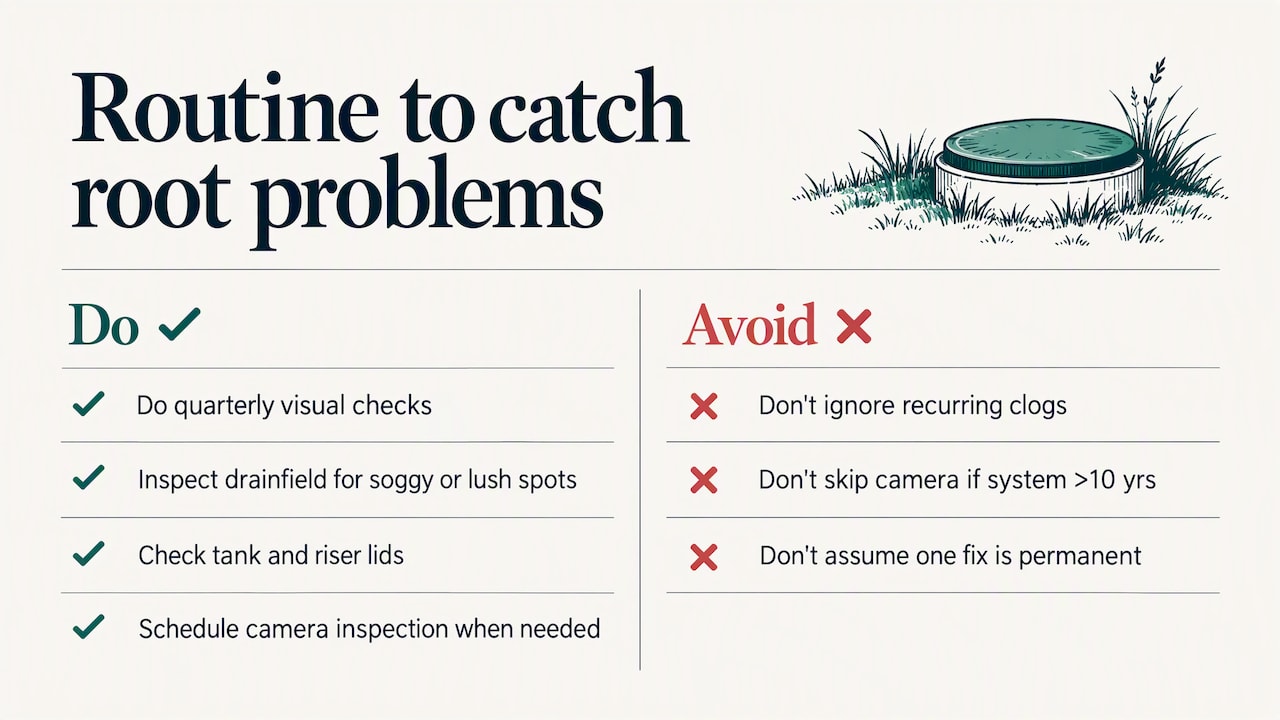
A quarterly visual check is enough to catch most developing problems before they become expensive. Walk the drainfield looking for soggy spots, unusually lush grass, or settling in the soil, and check that tank and riser lids remain seated and sealed.
Schedule a video camera inspection if you notice recurring clogs in the same fixture, a sewage smell that does not resolve after basic troubleshooting, or if your system is more than 10 years old and has never been scoped. Keeping a simple maintenance record, noting inspection dates, any root fragments found, and repairs made, gives you something concrete to hand a service provider instead of trying to recall details from memory. Our maintenance checklist for new homeowners is built for exactly this kind of tracking.
Cost expectations vary with the extent of excavation needed, the age and material of the affected pipe, and whether a tree needs to come out entirely. Budget for the likelihood of a follow-up treatment or barrier installation rather than assuming one fix solves the problem permanently.
Behind this guide: independent research for aerobic septic owners
Alex González creates and reviews the content on Aerobic Septic Owner, drawing on extension publications, trade reporting, and manufacturer documentation rather than any affiliation with a service provider or installer. That independence shapes how we cover topics like root intrusion: we aim to separate general homeowner education from the site-specific diagnosis only a licensed technician can provide.
Readers can pair this guide with our free maintenance schedule, red-flag checklist, and repair-versus-replace comparison, all available through our resources page.
Weighing a tree’s value against your septic system’s health
Trees add shade, privacy, and value to a property, and I understand not wanting to rip one out over a hypothetical risk. But prevention costs far less than repair, and a conservative planting distance decided before a tree goes in the ground is cheaper than any root barrier installed after the fact.
Keep records, act on inspection results instead of guessing, and treat our checklists as a planning tool rather than a one-time read.
— Alex
Put a maintenance routine in place before roots become a problem
Instead of guessing when something feels off, a short planning session with our downloadable maintenance schedule gives you dated tasks for inspecting lids, trenches, and pipe connections throughout the year.

Checklists and repair-versus-replace comparisons can help you prepare for a service call by clarifying what symptoms to describe, which tends to shorten diagnostic time and improve the quotes you receive. Start with the maintenance schedule and build your routine from there.
FAQ
What should I do if tree roots grow into a septic tank?
Stop using the system if you notice backups, odors, or standing effluent, and call a licensed septic technician for a camera inspection to confirm the location and extent of the intrusion. Depending on severity, the fix may involve mechanical removal, a root barrier, or excavation to repair the entry point directly.
What should never go into an aerobic septic system?
Aerobic systems are sensitive to harsh chemicals, grease, and non-biodegradable items that disrupt the bacterial and aeration processes they depend on. Avoid antibacterial cleaners in large volumes, flushable wipes, cooking grease, and excess water from leaking fixtures, all of which stress the system beyond normal operation.
How fast do tree roots grow back after removal from sewer pipes?
Roots often regrow within months if the entry point that let them in originally is not sealed or protected, according to trade coverage of root intrusion. Mechanical cutting alone clears the blockage but leaves the opening intact, which is why pairing removal with a barrier or pipe repair reduces how often the problem returns.
How much does it typically cost to clear tree roots from a sewer line?
Cost depends heavily on whether the fix is mechanical clearing, chemical treatment, or excavation and pipe repair, with excavation costing considerably more due to labor and landscaping restoration. Getting a camera inspection first helps you avoid paying for excavation when a simpler fix would resolve the immediate problem.
Sources
- Planting on Your Septic Drain Field (Virginia Cooperative Extension)
- Landscaping the drain field (IFAS/UF guidance)
- Getting to the root of pipe or tank infiltration | Pumper