
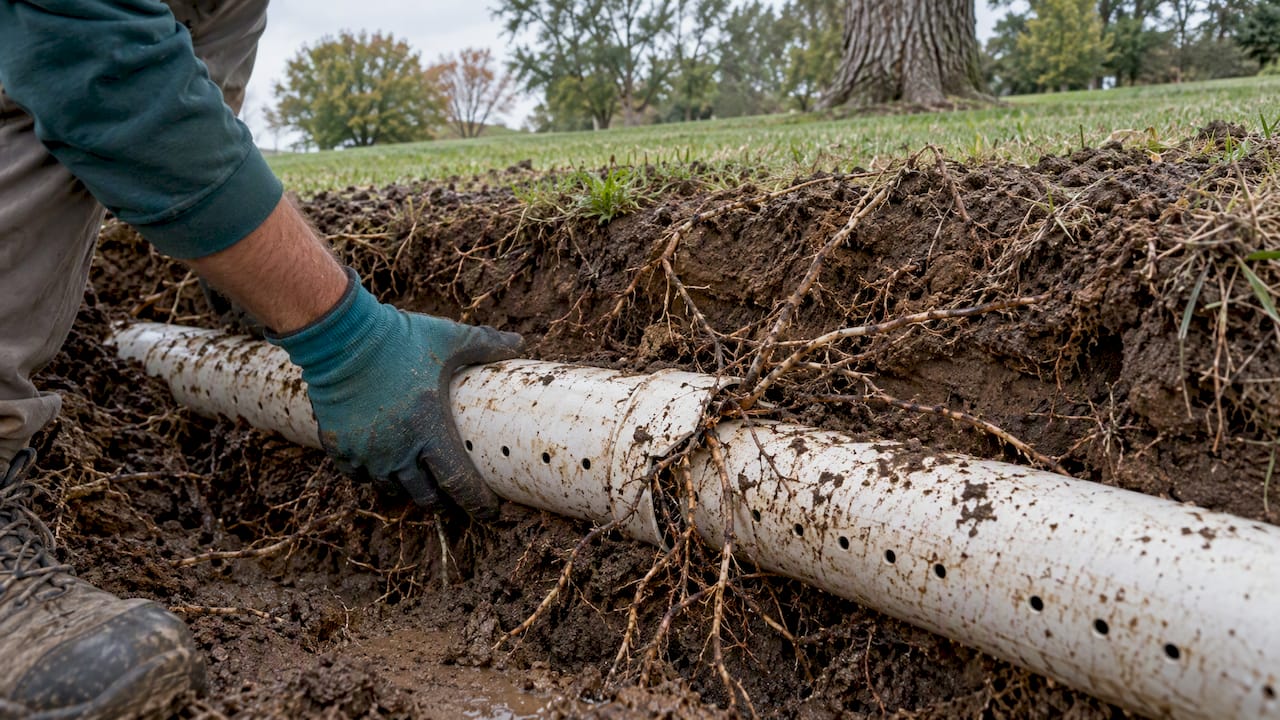
Tree roots can enter damaged septic pipes and components. Slow drains, recurring blockages, odors, and wet patches have several possible causes; they do not establish root intrusion on their own. A qualified septic professional can diagnose the affected component and recommend a repair.
Homeowner priorities: keep people and pets away from surfacing wastewater, reduce wastewater use if sewage is backing up, and contact your provider. Do not open tanks, dig around buried components, or add root-control chemicals.
Table of Contents
- Why tree roots can reach septic components
- Where roots enter: three zones worth checking
- Warning signs and how professionals diagnose root problems
- Removal and remediation: matching the fix to the damage
- Planting rules that keep roots away from your system
- A routine for reporting changes
- What to record and ask your provider
- FAQ
- Sources
Why tree roots can reach septic components
Risk depends on the trees, soil, component placement, and condition of pipes and seals. This guide does not establish that aerobic systems attract more roots than conventional systems. EPA recommends keeping trees an appropriate distance from the drainfield and consulting a septic professional about the distance for your landscape.
Where roots enter: three zones worth checking
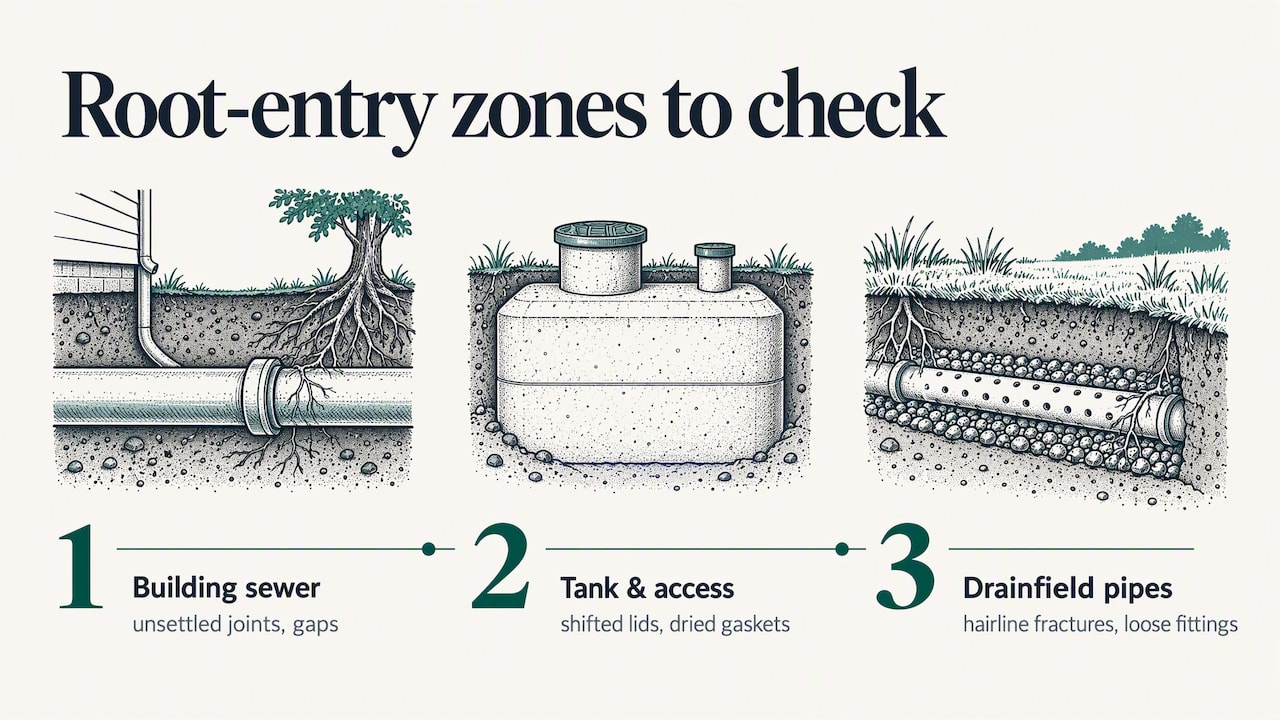
Root intrusion tends to concentrate in three distinct areas, and knowing which one is affected helps you describe the problem accurately to a technician.
The building sewer line, the pipe connecting your house to the tank, is often the oldest material on the property. Clay or cast iron sections and loosely fitted joints are classic entry points, since roots exploit any gap wider than a hair’s width. Industry reporting on infiltration problems points to unsettled joints and poor backfill as the primary vulnerabilities, more so than the pipe material itself, according to trade coverage of root and tank infiltration.
Tanks, pump chambers, and ATU access points are the second zone. Risers, lids, vent stacks, and the penetrations where pipes enter the tank wall are all potential gaps. A lid that has shifted slightly or a riser gasket that has dried out offers roots the same opportunity as a cracked pipe.
The drainfield itself, with its network of perforated distribution pipes, is the third and often hardest zone to inspect. Roots follow the oxygen and moisture these trenches release and, once they find a hairline fracture or a loose fitting, grow directly into the pipe interior, where they branch out and catch solids.
Warning signs and how professionals diagnose root problems
Several household symptoms point toward a developing root problem, though they can also signal unrelated septic issues, so pattern matters more than any single sign.
- Drains that empty slowly, especially in multiple fixtures at once, often mean a downstream blockage rather than a single clogged trap.
- Gurgling sounds from toilets or drains suggest air is trapped behind a partial obstruction.
- A persistent sewage odor near the tank, drainfield, or an indoor drain can indicate a cracked line or a lid that no longer seals, both covered in more detail in our guide to aerobic septic system smells.
- Soggy or unusually green patches over the drainfield, especially in dry weather, point to effluent surfacing instead of draining properly.
- Recurring clogs in the same fixture or line, despite cleaning, are a strong signal that something structural, like a root mass, is narrowing the pipe.
Visible root fragments pulled from a cleanout or found tangled around a lid are about as close to confirmed as a homeowner can get without equipment. Beyond that, diagnosis is a job for a professional. A video camera inspection lets a technician see root intrusion directly inside the pipe and pinpoint its location. Dye tracing, where a colored dye is flushed and tracked to the surface, helps confirm whether effluent is reaching the surface unexpectedly. Technicians also probe suspect areas and check watertightness at tank penetrations and riser seals, since a seal that lets water in during testing is a likely root entry point too.
If you see sewage backing up into the house, smell it strongly outdoors, or notice standing effluent on the surface, stop using the system immediately and call a licensed septic technician rather than attempting a DIY fix. For a broader list of symptoms worth tracking before they become emergencies, see our rundown of aerobic septic system red flags.
Removal and remediation: matching the fix to the damage
Ask the provider to identify the affected pipe or component and explain the evidence for root intrusion. Clearing a blockage does not repair a damaged joint. Depending on the inspection, the work may involve clearing an obstruction, repairing a pipe or seal, or replacing a damaged component.
Request an itemized scope, the permissions required, and a follow-up plan. Do not pour chemical root killers into the system. Excavation and any proposed root barrier should be planned by qualified professionals with the system layout and tree stability in mind; neither is a guaranteed permanent cure.
Planting rules that keep roots away from your system
Locate the tank, buried lines, and dispersal area from the approved system plan before planning trees or landscaping. Ask your septic provider and, when needed, an arborist about suitable planting distances and species. A single distance or barrier depth cannot account for every system and landscape.
Keep vehicles and heavy equipment off the drainfield. Avoid excavation, added soil, and new planting over buried components without professional advice. Maintain access for inspection and service.
A routine for reporting changes
From a safe distance, note new wet patches, settling, unusual vegetation, odors, and recurring drainage problems. These observations do not replace scheduled maintenance or establish the cause. Follow the inspection schedule in your permit and manufacturer instructions.
Keep dates, photographs taken safely, service reports, and repair records. Ask your provider whether the symptoms justify a camera inspection; system age alone does not determine that decision. Our resources help organize service records.
What to record and ask your provider
Write down, with dates: where you saw wet spots, settling or odors; which drains were slow; and any root pieces a provider showed you. Keep service reports with your free maintenance record.
What to ask your provider
- Which pipe or part is affected, and what shows it is roots?
- Will clearing it fix the opening, or does the joint or seal need repair?
- Does this work need a permit, and who may do it under my contract?
- What follow-up do you recommend?
- How far from the system should new trees go on my lot?
FAQ
What should I do if tree roots grow into a septic tank?
Stop using the system if you notice backups, odors, or standing effluent, and call a licensed septic technician for a camera inspection to confirm the location and extent of the intrusion. Depending on severity, the fix may involve mechanical removal, a root barrier, or excavation to repair the entry point directly.
How fast do tree roots grow back after removal from sewer pipes?
Regrowth depends on the tree, conditions, and whether the entry point remains. Ask the provider how the proposed repair addresses that opening and what follow-up is appropriate.
How much does it typically cost to clear tree roots from a sewer line?
No published source we use gives a reliable price. The cost depends on whether the fix is clearing, a pipe repair or excavation. Ask for a camera inspection finding and an itemized written quote.
Sources
- U.S. Environmental Protection Agency, How to Care for Your Septic System, for the drainfield guidance to plant trees an appropriate distance away to keep roots from growing into the system, with the note that a septic service professional can advise the proper distance depending on the tank and the landscape, and for the instructions not to park or drive on the drainfield and to keep roof drains and sump pumps away from it.
- U.S. Environmental Protection Agency, Types of Septic Systems, for the buried components a root system can reach and why dispersal depends on them.
- Texas A&M AgriLife Extension, B-6234, “Living with an Aerobic Treatment Unit and Spray Field”, for the hazards of excavating or working around a spray field.
- Texas Commission on Environmental Quality, OSSF maintenance guidance, 30 TAC §285.90, for who may lawfully carry out the repair once roots have reached a permitted installation.