
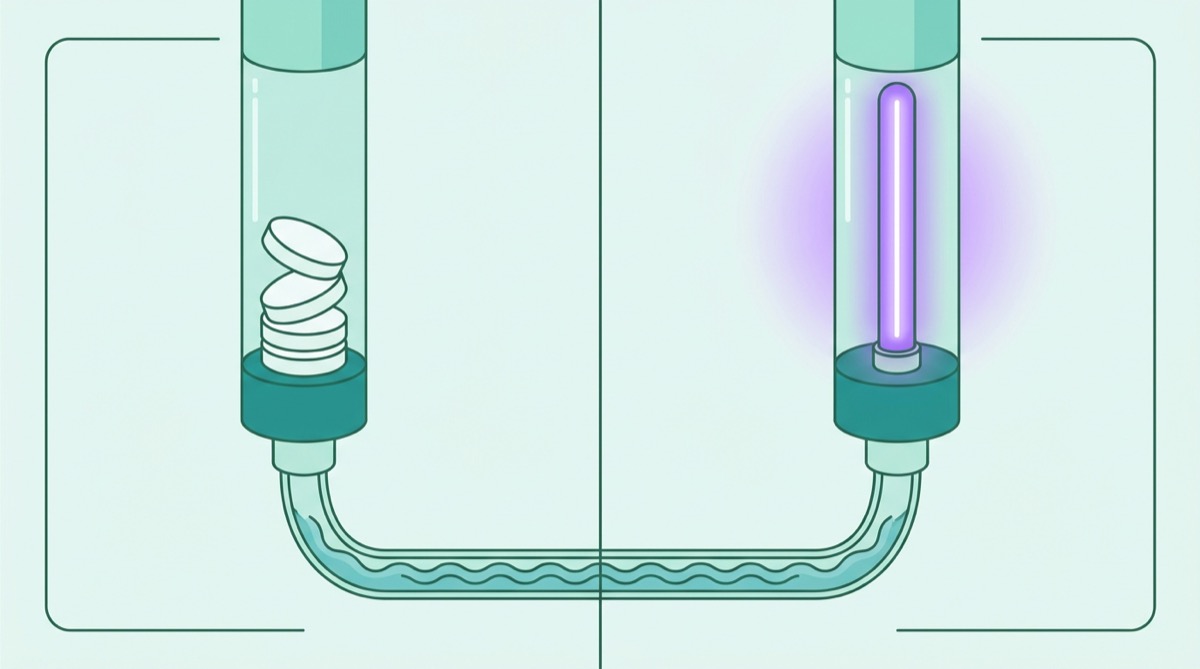
Most aerobic septic systems disinfect treated effluent with chlorine, and some use ultraviolet (UV) light instead. Neither is automatically better: chlorine depends on the right product reaching the water, while UV depends on clear effluent, a working lamp and steady power. For an existing system, the practical question is usually not which one to buy but which one you have, what it needs, and who is responsible for it.
This guide compares the two methods from an owner’s point of view. It is not a design guide. Whether a system can be changed from one method to the other is a question for your provider and your permitting authority.
Why aerobic systems disinfect at all
Aerobic treatment lowers the pollutant load in wastewater, but treated effluent can still contain pathogens. EPA notes that some aerobic units include a final treatment tank with disinfection to further reduce pathogen levels, while others rely on the basic aerobic process alone. So disinfection is not part of every unit.
West Virginia University’s onsite wastewater program explains that disinfection is generally needed when effluent is surface-discharged or reused right away; otherwise it is usually filtered through soil in an absorption system. Texas A&M AgriLife Extension lists the situations in which disinfection is required: when people may contact the effluent, when the soil will not disinfect it, and for spray-distributed reuse systems. That is why disinfection matters so much on properties with spray heads in the yard.
The performance target comes from your rules, not from the equipment brochure. AgriLife reports that Texas requires fecal coliform below 200 CFU per 100 mL for surface distribution. Other states set their own terms, so check your permit and our state-by-state rules page.
Chlorine vs UV at a glance
| Factor | Chlorine | Ultraviolet |
|---|---|---|
| How it works | Chemical added to the effluent; breaks down pathogens’ cell enzymes | Lamp exposes flowing effluent to light that damages genetic material |
| Common form | Tablet feeder; some systems use liquid | Lamp inside a quartz or Teflon-coated sleeve |
| Needs electricity? | Gravity-fed tablet feeders do not | Yes; an outage stops disinfection |
| Main consumable | Wastewater-rated disinfectant | Replacement lamp |
| Chemical residual | Yes; can harm receiving water | None |
| Biggest weakness | Inconsistent tablet feeding | Cloudy effluent shields organisms from the light |
How chlorine disinfection works
AgriLife calls chlorination the most common form of disinfection for aerobic systems and describes two kinds of equipment: tablet chlorinators and liquid chlorinators. Chlorine lowers pathogen counts by breaking down cell enzymes, and how well it works depends on contact time, dose, temperature and pH.
Where chlorine does well
- Long track record. A technology fact sheet on onsite effluent disinfection describes chlorine as a proven disinfectant over roughly a century of use.
- Low power dependence. The same fact sheet notes that gravity-fed tablet feeders need no electricity.
- Simple supply. The consumable is a product you can keep on hand, provided it is the correct one.
Where chlorine falls short
- Uneven dosing. The fact sheet reports a history of erratic tablet feeding, with both overdosing and underdosing common. Listed problems include solids building up in the chlorinator, tablets caking, tablets failing to drop and gaps in supply.
- Field results can disappoint. In one field study the fact sheet cites, tablet chlorinators following biological treatment exceeded the 200 FC/100 mL standard 93% of the time, and 68% of samples had no chlorine residual. That is one study, not a prediction for your system, but it shows why tablets in a feeder do not prove the water is disinfected.
- Cold slows it. The fact sheet gives design contact times of 1 hour at 20 °C, 2 hours at 10 °C and 8 hours at 5 °C.
- Residual concerns. WVU notes that where residual chlorine is high enough to harm receiving water, dechlorination may be needed.
- Handling hazards. TCEQ says not to use swimming-pool tablets and warns of an explosion danger with them. AgriLife warns that tablets release chlorine gas and should not be stored in the house, the garage or near metal tools.
TCEQ states that calcium hypochlorite tablets certified for wastewater disinfection will kill 99% of the bacteria present in the effluent within 10 minutes. That describes the chemistry working as intended; the field data above is a reminder that real feeders do not always deliver it. For product and handling details, see our guide to chlorine tablet safety and common mistakes.
How UV disinfection works
In a UV unit, a lamp shines through a quartz or Teflon-coated sleeve into effluent flowing past it in a thin film. AgriLife explains that UV is germicidal between 250 and 270 nanometers and is most effective for wastewater at 254 nm. The light damages genetic material so that organisms die or cannot reproduce. Contact time is short, usually 6 to 40 seconds according to AgriLife.
Where UV does well
- No added chemical. WVU notes that UV produces no toxic residuals, and it has become widely used for small-scale systems.
- No chemical storage. There are no tablets to buy or store at home.
- Strong results on clear water. The fact sheet reports typical units achieving more than 3-log fecal coliform removal under suitable conditions.
Where UV falls short
- It needs clear effluent. Suspended solids can shield organisms from the light. AgriLife warns that wastewater with too much turbidity will not be disinfected properly, so UV relies heavily on the aerobic stage upstream working well. Hardness, iron and pH can also affect performance.
- It needs power. The fact sheet notes that outages stop disinfection. See what to do after a power outage.
- No lasting protection. Because UV leaves no residual, there is nothing to keep working after the water leaves the lamp. An EPA fact sheet written for combined sewer overflows rates regrowth likelihood as high for UV; that is a different setting from a home system, but the principle is the same.
- Parts have service lives. See the next section.
- Temperature exposure. AgriLife says to protect the lamp from dust, excessive heat and freezing.
AgriLife also cautions that viruses are harder to destroy than bacteria, so a coliform-free test does not mean nothing else survived. That caution is about the limits of testing, and it is a good reason to avoid contact with sprayed effluent under either method.
Maintenance and running needs compared
The published figures below are general ranges from extension and technical sources. Your manufacturer’s instructions and permit take priority.
| Item | Chlorine | UV |
|---|---|---|
| Routine work | Service feeder, add disinfectant, clean contact tank, sample residual | Clean or replace lamps and sleeves, check controls, monitor intensity |
| Published effort | About 6–10 hours a year | About 10–12 hours a year |
| Replacement parts | Consumable disinfectant; about 5–15 lb of available chlorine a year for a family of four | Lamp every 12–24 months per manufacturer; sleeves about every 5 years; ballast about every 10 years |
| Cleaning | Solids can build up in the chlorinator | Quartz sleeves one to four times a year or more; Teflon-coated sleeves do not need cleaning |
| Electricity | Little or none for gravity-fed feeders | About 1–1.5 kWh a day |
Effort figures and the chlorine quantity come from the onsite fact sheet; lamp, sleeve, ballast and power figures come from AgriLife. Treat the hours as a comparison rather than a to-do list: much of this is trained-service work. The fact sheet also publishes dollar figures, but they are not a reliable guide to today’s prices, so ask for a current quote. To see how UV’s power draw fits into the whole system, read how much electricity an aerobic septic system uses.
AgriLife recommends running UV bulbs continuously because repeated on/off cycles shorten their life. If your unit has an intensity sensor or alarm, a drop can come from an aging bulb, buildup on the sleeve or cloudy effluent, so a warning does not automatically mean a bad lamp.
Safety: what owners should leave alone
UV looks harmless because there are no chemicals, but the hazards are real. EPA’s overflow fact sheet notes that UV exposure can cause burns, eye damage and cataracts, and AgriLife says never to look directly at the light with the power on. UV units also involve electrical connections in a wet environment.
- Do not open tanks, UV housings or control panels to investigate a problem.
- Do not look into a UV unit or try to clean or change a lamp unless your manual and provider have shown it is an authorized owner task.
- Do not add chlorine products to a UV-only system, or substitute one chlorine product for another.
- Follow the label for any disinfectant, and keep children and pets away from system components.
How to tell which one your system uses
You cannot reliably tell from the yard. Start with your owner’s manual, your permit documents and your latest service report, then ask your provider to confirm in writing:
- the disinfection type, make and model;
- the exact product or replacement lamp specified;
- how often it is checked, and how the result is recorded;
- who is responsible for supplies, cleaning and replacement parts.
That last point deserves attention. TCEQ says a maintenance contract should identify who is responsible for maintaining the disinfection unit. If your agreement is vague, use our notes on what to check before signing a contract. For where this stage sits in the system, see our components guide.
Can you switch from chlorine to UV?
Do not assume so. Disinfection is part of how the system was designed and permitted, and UV depends on effluent clarity that your existing treatment stage may or may not deliver. If you are curious about a change, ask your provider whether your unit and effluent quality are suitable, then ask your permitting authority whether a change needs approval before any work happens. We did not find a single national rule on this, and requirements vary by location.
FAQ
Is UV better than chlorine for an aerobic septic system?
Not in every case. UV avoids chemical residuals but needs clear effluent, regular upkeep and steady power. Chlorine works without electricity in gravity-fed feeders but can dose inconsistently. The right comparison is the equipment actually approved for your system.
Does a UV system need chlorine tablets?
Not necessarily. Some systems use UV and no chlorine, but confirm it with your provider before buying any product or assuming that a chlorinator is absent.
How often is a UV bulb replaced?
AgriLife gives 12 to 24 months based on manufacturer recommendations, and also notes yearly replacement where the manufacturer or permit requires it. Your manual and permit decide.
Can I tell whether disinfection is working by looking at the water?
No. Clear water or tablets in a feeder do not prove that disinfection is working. Performance is confirmed by the testing your permit requires, carried out by whoever is responsible for it.
Free email lessons for aerobic septic owners
You confirm by email before Lesson 1 is sent. See our privacy policy.
Sources
- Texas A&M AgriLife Extension, L-5483, Ultraviolet Disinfection.
- Texas A&M AgriLife Extension, B-6234, Living with an Aerobic Treatment Unit and Spray Field.
- West Virginia University, Disinfection options for onsite wastewater systems.
- Technology fact sheet, Effluent Disinfection Processes (TFS-17), hosted by a county health department in Indiana.
- U.S. EPA, Combined Sewer Overflow Technology Fact Sheet: Alternative Disinfection Methods (EPA 832-F-99-033).
- U.S. EPA, Types of Septic Systems.
- Texas Commission on Environmental Quality, OSSF maintenance guidance.