
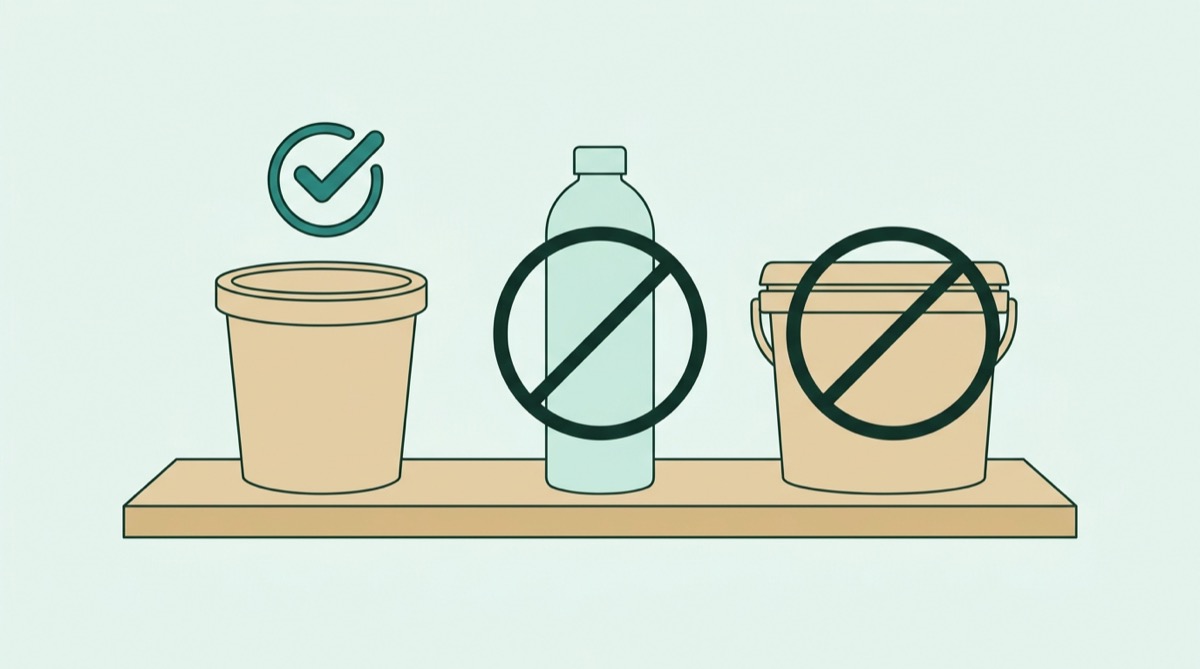
Most aerobic septic owners need very few products. If your system uses a tablet chlorinator, the main purchase is the wastewater-disinfection product specified for that equipment, unless your provider supplies it. Almost everything sold to “boost” or “treat” a system can be skipped. Before you buy anything, find out what your manual requires and what your maintenance contract already covers.
We do not sell these products, and this page has no affiliate links.
Do you need it?
| Product | Do you need it? | What to check first |
|---|---|---|
| Wastewater chlorine tablets | Only with a tablet chlorinator | The exact product for your equipment, and who supplies it |
| Swimming pool tablets | No | TCEQ warns against them in aerobic systems |
| Liquid disinfectant | Only with a liquid-feed unit | The product and strength your manual names |
| Chlorine test strips | Only if checking is your job | Ask your provider which test to use and what result to look for |
| Bacteria, enzyme or “starter” additives | No | University programs advise against them |
| Chemical drain openers | No | EPA suggests boiling water or a drain snake |
| Air pump filter | Only if your manual makes it an owner task | The exact pump model. Otherwise leave it to your provider |
| Air pump rebuild kit | Provider work in most cases | The exact model, your contract and your local rules |
| Replacement air pump | Only after a diagnosis | The air output your design calls for |
| Spray heads and nozzles | Only if your provider specifies them | Flow, pressure and pattern must match the design |
| Vent carbon filter | Sometimes, for yard odor | It must not block airflow, and it can freeze in cold climates |
| Tank risers | Sometimes, for buried lids | Ask your provider and check your local rules |
Disinfection products: buy the exact one
This is the purchase that matters most, and the one people get wrong most often. TCEQ identifies calcium hypochlorite tablets approved for wastewater disinfection, and warns that pool tablets commonly contain a different chemical, trichloroisocyanuric acid. A listing that says “chlorine” or “septic” does not tell you it is right for your feeder.
Ask your provider to write down the exact product name. Then check whether your contract already includes it, because you may be about to pay twice. Our guide to chlorine tablets covers storage and common mistakes, and our chlorine vs UV guide explains why some systems need no chlorine at all.
Additives and bacteria products: skip them
Search for aerobic septic products and you will find bottles and packets promising more bacteria, fewer odors or a longer life for your system. Some are marketed with terms such as “bacteria generator.” The evidence does not support buying them for a working system.
- The University of Minnesota’s program says additives are not recommended, that there is no independent research verifying their effectiveness, and that they risk upsetting the natural activity in the system.
- Texas A&M says it is not necessary to pour additives, yeast or other materials down the drains, because the microorganisms occur naturally.
- University of Nebraska–Lincoln Extension says some of these products do nothing and others may damage the system.
If a product is being sold to fix a smell, an alarm or a wet yard, the problem needs a diagnosis, not a bottle. Start with our symptom guide.
Air pump parts: buy by the nameplate
Air pumps that look the same can have different air output, and rebuild kits are specific to the model. Write down the manufacturer, model and rated output from the nameplate, and compare the output with what your design calls for. Before anyone opens a pump, check your warranty and contract, because fitting your own part can affect your coverage.
Also check whether you are allowed to do the work at all. In Texas, TCEQ says some homeowners may maintain certain systems after the first two years, but local authorities may require training or prohibit it. If you are being quoted for a repair, our quote comparison guide has a free worksheet.
Before you buy anything
- Does my manual or provider say this product is needed?
- Is it already covered by my maintenance contract?
- Does it match my exact equipment?
- Am I allowed to install or use it under my contract and local rules?
- What problem is it meant to solve, and has anyone confirmed that problem?
If you cannot answer all five, wait and ask your provider.
What is worth having, and costs nothing
- Your permit, manual and maintenance contract in one place.
- A photo of each equipment nameplate, taken from a safe spot.
- Your provider’s phone number where the whole household can find it.
- A simple service log. Our free resources page has printable records.
- A list of what not to put down the drain.
Sources
- Texas Commission on Environmental Quality, Maintenance of On-Site Sewage Facilities.
- University of Minnesota Onsite Sewage Treatment Program, Outdoor septic odor causes and solutions.
- Texas A&M AgriLife, Onsite wastewater frequently asked questions.
- University of Nebraska–Lincoln Extension, Manage solids, keep hazardous materials out, let system work.
- U.S. Environmental Protection Agency, How to Care for Your Septic System.
General information only. Your manual, your permit, your local authority and a qualified provider decide what is correct for your system. Last updated: November 9, 2026.