
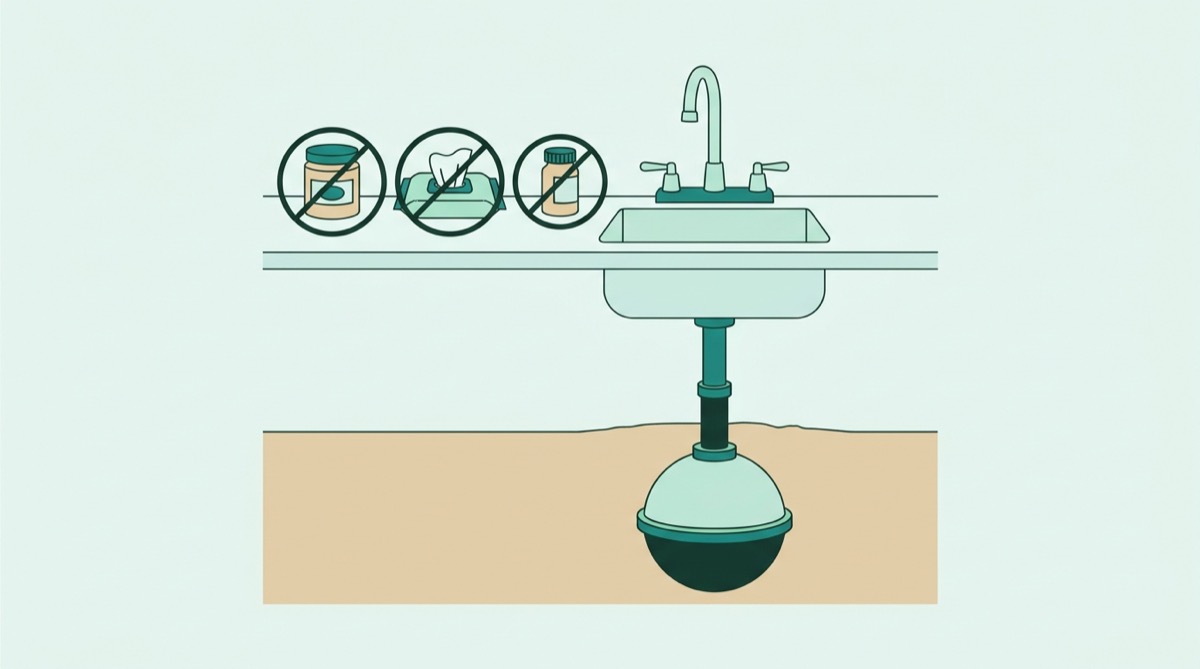
Only human waste, toilet paper and ordinary household wastewater belong in an aerobic septic system. Normal amounts of everyday cleaners are usually fine. Grease, wipes, medications, drain openers, paints and solvents are not. The table below gives the short answer for each item, and the rest of this guide explains the reasons and what to do if something has already gone down.
Can it go down the drain?
| Item | Answer | Why, and what to do instead |
|---|---|---|
| Human waste and toilet paper | Yes | The only things EPA says to flush |
| Everyday cleaners and antibacterial soap, in normal amounts | Usually fine | Excessive use is the concern, so follow the label dose |
| Cleaners labeled Danger | Rarely or never | Texas A&M says the Danger label means the chemical will kill the microbes |
| Chemical drain openers | No | EPA suggests boiling water or a drain snake instead |
| Automatic toilet bowl dispensers with bleach | Avoid | They release a constant antibacterial agent into the system |
| Medications | No | Use a take-back program. See the medication section below |
| Grease and cooking oil | No | Can clog plumbing and add scum. Let it cool and put it in the trash |
| Food scraps through a garbage disposal | Limit, and ask first | Adds solids and shortens the time between pump-outs |
| Wipes, diapers, feminine products, dental floss, paper towels, cat litter | No | Put them in the trash, even if a package says flushable |
| Coffee grounds | No | On EPA’s do-not-flush list. Trash or compost them |
| Paint, solvents, pesticides, antifreeze, gasoline | No | Take them to a household hazardous waste collection |
| Septic additives, starters and yeast | Not needed | The microorganisms occur naturally, and some products may do damage |
Why this matters more with an aerobic system
An aerobic treatment unit depends on living microorganisms. The air pump supplies the oxygen and your household supplies the food. Texas A&M’s onsite wastewater program notes that an organically overloaded unit needs more frequent maintenance, and that strong chemicals and prescription drugs are hard on those microbes. EPA adds that toxins can kill the organisms that treat waste, and that harmful chemicals can reach groundwater.
There are two separate risks. Some items poison the treatment, and others simply add solids or block the plumbing. Both cost money. If you are not sure how the parts fit together, our guide to what an aerobic septic system looks like shows each stage.
Cleaners, bleach and antibacterial soap
You do not need to give up normal cleaning. University of Nebraska–Lincoln Extension says a system can handle normal amounts of household cleaning products, including antibacterial soaps. The problem is excess.
The label is the quickest guide. Texas A&M says products labeled Danger will kill the microbes and should be used rarely or never, Warning products should have a limited effect with limited use, and Caution products typically have little effect.
We did not find extension guidance that gives a safe amount of laundry bleach. Treat it like any other cleaner: use the label dose, do not add extra, and mention it to your provider if your household uses a lot. Nebraska Extension does single out automatic toilet dispensers containing bleach, because they keep releasing an antibacterial agent into the tank.
Never pour bleach or any other product into the system to treat a smell or an alarm. Disinfection products go only where your equipment specifies, as our guide to chlorine tablets explains.
Medications
EPA lists pharmaceuticals among the things never to flush, and Texas A&M warns that antibiotics and other drugs are hard on the system’s microbes. Use a pharmacy or community take-back program where one exists. The FDA explains the disposal options. If someone at home is taking a long course of strong medication, tell your provider. It is useful context if the system starts to behave differently.
Garbage disposals
This is the question with the clearest cost attached. EPA advises limiting or stopping disposal use, because it adds fats, grease and solids and means more frequent pumping. Nebraska Extension says heavy use may mean pumping about twice as often. For aerobic systems specifically, Texas A&M says a disposal may shorten pump-out intervals by one to two years.
If you have a disposal, use it sparingly. If you are thinking of adding one, the Champaign-Urbana Public Health District tells aerobic owners to check with their local regulatory agency first. Ask your provider too, and put any extra pumping into your yearly budget.
A slow drain is not a reason to reach for chemicals
EPA recommends boiling water or a drain snake over chemical openers. If several drains are slow at once, or the panel shows an alarm, the problem may be beyond one pipe. Cut your water use and start with our symptom guide.
If something has already gone down
- Stop adding more. Do not pour in another product to cancel it out, and do not add a starter or additive.
- Read the product label for any first aid or disposal instructions.
- Write down what it was, roughly how much, and when.
- Tell your maintenance provider, especially if it was a large amount or a hazardous product, and ask whether you should change anything until they have looked at it.
- Watch for changes. Report a new smell, an alarm, or cloudy discharge. Our odor guide helps you describe what you notice.
A one-time small amount of a household product may never cause a visible problem, but we cannot tell you that for your system. Your provider can.
Do not forget the volume of water
What goes down the drain is one half of the question. How much and how fast is the other. EPA recommends spreading laundry through the week, and Texas A&M warns that several loads back to back can stir up solids in the tank. Our guide to how much water an aerobic system can handle covers that side.
Sources
- U.S. Environmental Protection Agency, How to Care for Your Septic System.
- Texas A&M AgriLife, Onsite wastewater frequently asked questions.
- University of Nebraska–Lincoln Extension, Manage solids, keep hazardous materials out, let system work.
- Champaign-Urbana Public Health District, Home aerobic system do’s and don’ts.
- U.S. Food and Drug Administration, Disposal of unused medicines.
General information only. Your manual, your permit, your local authority and a qualified provider decide what is correct for your system. Last updated: November 9, 2026.