
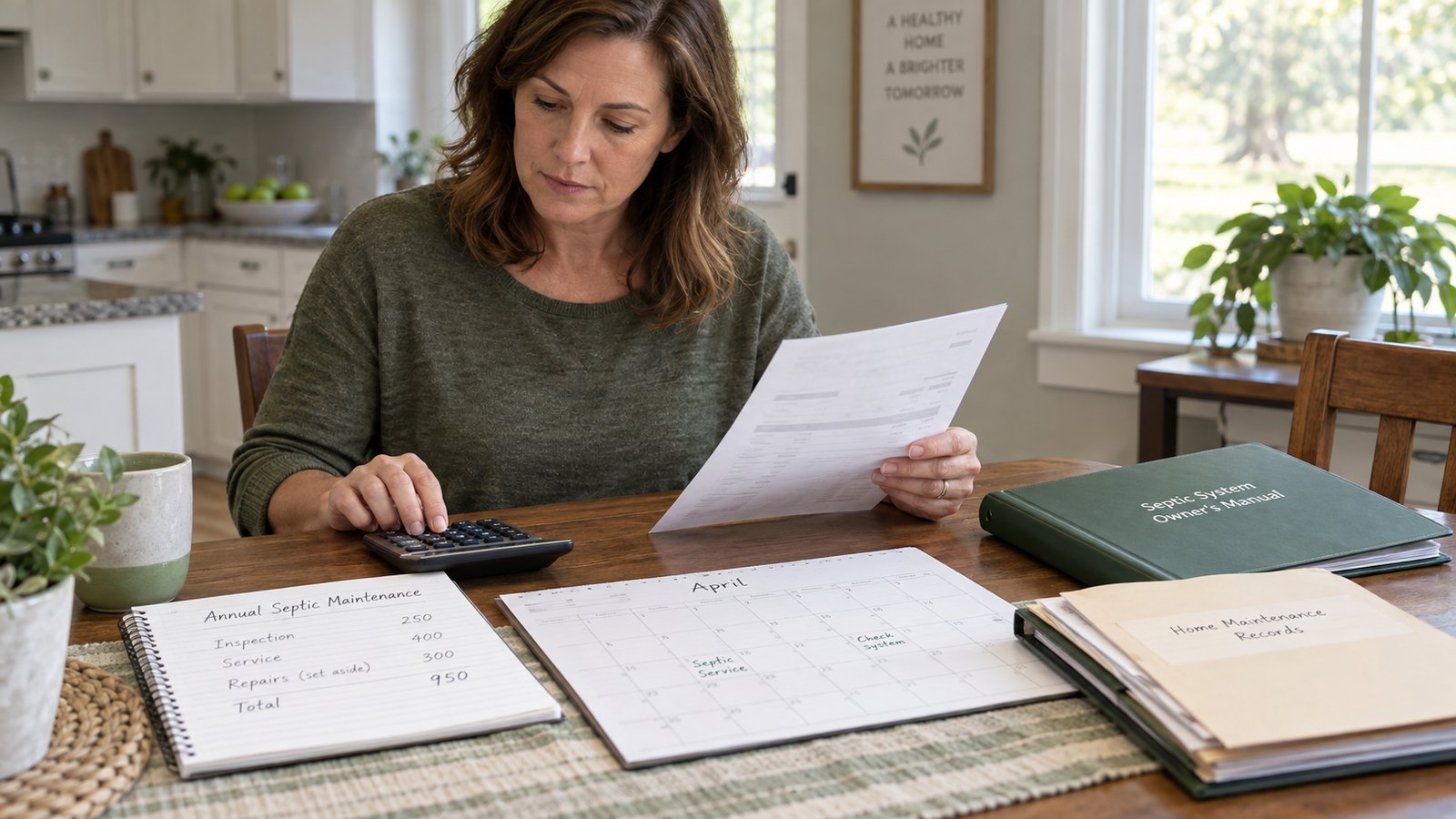
An aerobic septic maintenance contract is only one part of the annual ownership cost. A useful budget also accounts for electricity, required supplies, pumping when needed, and repairs or unscheduled visits that the agreement excludes.
Published provider examples reviewed on October 28, 2026 include basic inspection plans at $300 per year. These are specific advertised offers, not a national average or a quote for your property. Confirm current pricing, eligibility, and written coverage with a local provider.
Published maintenance prices: what they include
| Provider example | Published price | Important context |
|---|---|---|
| K & K Septic Services, Georgetown, Texas | $300 for one year | Three aerobic inspections with reports; additional charges apply to repairs, unscheduled visits, and other excluded work. |
| Bramlett Enterprises (Decatur, Texas) basic plan | $300 per year | Three inspections; the basic plan assigns chlorine responsibility to the customer. |
| Bramlett basic plan with chlorine | $350 per year | The advertised addition supplies chlorine at inspection visits; confirm ongoing supply responsibility in the agreement. |
Sources: K & K’s published agreement and Bramlett’s plan descriptions. These examples illustrate coverage differences and are not endorsements. The sample is too small and geographically limited to establish a US price range.
Separate six cost categories
1. Scheduled service and reporting
Ask for the number of visits, the work included, and any required reporting. Confirm whether the quoted amount covers the full contract period and whether the installation needs an initial assessment or repairs before coverage starts. Do not assume a cheaper plan includes the same tasks as a more expensive one.
2. Electricity
Use the power draw and actual operating schedule of each component, together with your electricity rate. For a simple estimate, multiply kilowatts by operating hours and the price per kilowatt-hour. Add the results for separate components. Our electricity guide shows how to find a component’s wattage on its nameplate and turn it into a yearly cost.
For example, a hypothetical 60-watt device operating 24 hours daily uses 43.2 kilowatt-hours in a 30-day month. At an assumed $0.16 per kilowatt-hour, that is about $6.91 monthly. This arithmetic is not an estimate for your particular system: other components, operating schedules, and rates change the result. Do not change equipment timers to achieve the example’s cost.
3. Disinfection supplies and other consumables
Budget only for products your installation actually requires. Determine who purchases and replenishes them and whether the service agreement covers all use or only supplies at scheduled visits. Use receipts to establish your own annual spending once you have enough records.
Product compatibility matters more than the lowest container price. Our chlorine tablet guide explains what to confirm before purchasing wastewater-disinfection supplies.
4. Pumping
Confirm whether pumping is included; do not assume an inspection contract covers it. Request a separate quote identifying the tanks or compartments serviced, access work, hauling, disposal, and any additional charges. Ask the provider how the need and next assessment date will be determined.
EPA identifies household use, solids, and tank size among the factors affecting pumping needs in its septic care guidance. Do not turn a generic interval into a guaranteed schedule for your aerobic installation.
5. Repairs and unscheduled attendance
Keep callout fees, diagnostic work, parts, labor, and after-hours charges separate. Ask whether a quoted diagnostic fee is credited toward an authorized repair. Check any warranty’s eligible components and exclusions instead of assuming “full service” pays every bill.
6. Locally applicable fees or testing
Ask the permitting authority and provider whether your property has separate reporting, permit, sampling, or laboratory charges. Enter confirmed amounts in the budget. Do not add a fee simply because another homeowner in another county pays it.
A worked budget example
The following figures are hypothetical planning inputs, not a market estimate or a provider offer. Replace every line with your own quote, records, or equipment calculation.
| Budget line | Illustrative annual amount |
|---|---|
| Scheduled service | $350 |
| Electricity | $120 |
| Supplies not included in service | $80 |
| Pumping reserve | $150 |
| Repair reserve | $300 |
| Total planning allocation | $1,000, or about $83.33 per month |
Only $550 in this example represents the assumed recurring service, electricity, and supply spending. The other $450 is money set aside for future work, not proof that a bill will occur this year. A major repair can exceed the reserve, and an uneventful year may leave it unused.
Compare quotes on the same worksheet
For each provider, record the contract term, visit count, included testing and reporting, supplies, callout process, repair authorization process, exclusions, renewal terms, and total price. Mark unanswered questions as unknown rather than treating them as included.
For Texas contracts, our maintenance contract guide explains what to check before signing.
For example, an offer that includes supplies at three visits may still leave the owner responsible between visits. An emergency response promise may describe when the provider responds to a call rather than when a repair will be completed. Request clarification in writing.
Build a more reliable budget after the first year
Keep every invoice and label it by cost category. Separate one-time work from recurring expenses, and record any unfinished recommendations. Review these alongside the maintenance calendar before renewing a contract.
For a home purchase, request recent service and repair records as part of the inspection checklist. The seller’s previous spending is useful context, but it does not establish the condition of the system or what your future costs will be.
For a substantial proposed repair, request the diagnosis and scope before comparing prices. Our repair-versus-replacement guide can help organize that discussion. A low routine fee should not distract from unresolved equipment or dispersal problems.
Budgeting is easier once you know what wears out and when over the life of an aerobic system.
Sources
- U.S. Environmental Protection Agency, How to Care for Your Septic System, for the factors EPA identifies as affecting pumping need (household size, total wastewater generated, volume of solids in wastewater and septic tank size), for the three-year inspection and three-to-five-year pumping interval for conventional systems, and for the annual inspection guidance and service contract note that apply to systems with mechanized parts.
- Texas Commission on Environmental Quality, OSSF maintenance guidance, for the reports to the permitting authority and owner at least once every four months (30 TAC §285.90(3) is the sample report form) that a Texas maintenance contract has to deliver, which is what the service line in a budget is paying for.
- Florida Administrative Code, Rule 62-6.012, for the requirement that a maintenance agreement be in effect for the life of the system in Florida, which makes the contract a permanent budget line rather than an optional one.
- Oklahoma Administrative Code, OAC 252:641-10-3, for the two years of maintenance owed by the installer at no additional cost to the owner, which an Oklahoma owner does not pay for during the first two years after installation; after that, the owner is responsible for maintenance.
Prices are published examples checked on the date stated above and may change. Obtain a property-specific written quote before making a spending decision.
Last reviewed: October 28, 2026.