
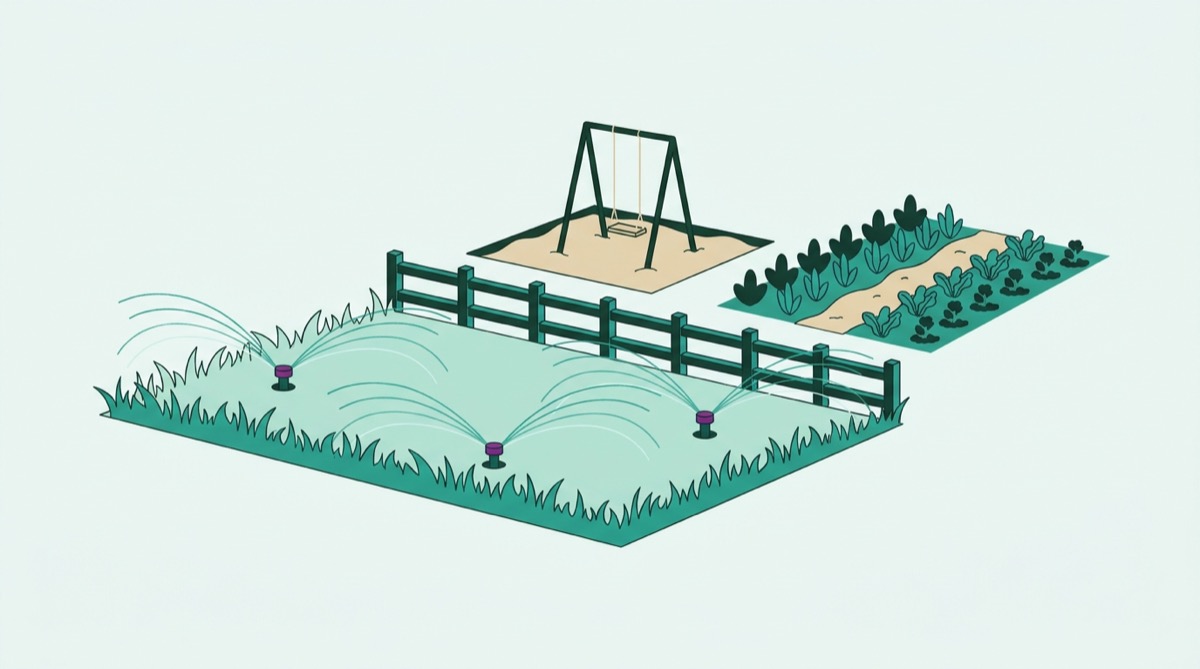
The water from an aerobic septic spray system has been treated, but it is still wastewater and it may still contain germs. Keep children and pets out of the spray, do not use it on anything you will eat, and never treat those heads like a garden sprinkler. The exact rules depend on your state and your permit, so this guide gives the practical answers first and uses Texas as a worked example of the rules.
Quick answers
| Your question | Short answer |
|---|---|
| Can children play on the spray area? | Not during spraying or while it is wet. Ask your provider when it doses and plan play elsewhere |
| What about pets? | Same answer. Keep them out of the spray, and do not let them drink from puddles |
| How long after spraying is it safe? | We found no published waiting time, so we will not give you one. Ask your provider and local health department |
| Can I grow vegetables there? | No. Texas excludes land used for food crops or gardens from the spray area, and EPA says not to plant vegetable gardens on a drainfield |
| Can I connect a hose or water the garden with it? | No. It is part of a permitted system, not a water supply |
| What can grow there? | Generally grass and other approved landscaping. Check your design first |
| Can I move a head that hits the fence? | Do not move it yourself. Ask your provider, because where the water lands is part of the design |
| The spray reaches my neighbor’s yard | Report it to your provider promptly. It can be a compliance problem as well as a nuisance |
Why it needs more care than a lawn sprinkler
A spray system looks like irrigation, but it disperses treated wastewater. Texas A&M’s onsite wastewater program notes that water from spray heads may still contain pathogens, which is one reason a healthy vegetative cover matters. Treatment and disinfection reduce the risk. They do not make the water suitable for drinking, for washing or for play.
Disinfection also depends on the equipment working and being supplied correctly. If the spray looks cloudy or smells foul, keep people and pets away and call your provider. Our guides to chlorine tablets and chlorine vs UV disinfection explain how that stage works.
Children, pets and visitors
- Find out when your system normally doses. Many spray in the early hours, but do not assume yours does.
- Tell the household, and guests with children, which part of the yard is the spray area.
- Keep play equipment, sandboxes and pet runs out of it.
- Do not let anyone drink from a head, wash with the water, or play in the spray.
- If someone is sprayed, wash the skin with soap and clean water. If you are worried about an illness, ask a medical professional and tell them what the exposure was.
Gardens, trees and landscaping
EPA warns against planting trees, shrubs or vegetable gardens on a drainfield, since roots can damage pipes and vegetables may be exposed to effluent. Spray systems have their own design rules, which can allow planting that a buried drainfield does not. Texas is a clear example. Under 30 TAC §285.33(d)(2):
- The area must be covered with grasses, evergreen shrubs, bushes, trees or landscaped beds with mixed vegetation.
- Nothing that would interfere with uniform application may be within ten feet of a sprinkler.
- Land used for food crops or gardens is excluded from the application area.
- Bare ground must be seeded or sodded before the system starts up.
Before you plant, build or add a fence, check your approved design, and ask whether the change would block the spray. Our guide to tree roots and aerobic systems covers planting near pipes and tanks.
Neighbors and property lines
Texas also sets rules that show how seriously drift is taken. If the application area is less than 20 feet from a property line, the rule requires sprinklers on timers, spraying only between midnight and 5:00 a.m. New distribution piping, valve box covers and sprinkler tops must be permanently colored purple to identify the water as reclaimed. Texas A&M also says that by law, water leaving your property must meet quality standards.
So a head that sprays over a fence or into a street is worth reporting even if nobody has complained. Other states have different rules. Our state-by-state comparison shows how much they vary, and your permit is the document that applies to you.
Signs something is wrong
- Spraying at an unusual time, or during rain. Our sprinkler guide explains what that can mean.
- Cloudy, gray or foul-smelling water.
- Standing water or spongy ground. See our wet spot guide.
- A broken head that gushes instead of spraying.
In any of these cases, keep people and pets away, note what you saw and when, and contact your provider.
What to ask your provider
- When does my system normally spray?
- Exactly where is the approved spray area?
- What can I plant or build near it?
- Who supplies the disinfectant, and how is it tested?
- What should I do if the spray reaches a neighbor’s property?
Sources
- Texas Administrative Code, 30 TAC §285.33, Criteria for Effluent Disposal Systems.
- Texas A&M AgriLife, Onsite wastewater frequently asked questions, and Living with an Aerobic Treatment Unit and Spray Field.
- U.S. Environmental Protection Agency, How to Care for Your Septic System.
General information only. Your manual, your permit, your local authority and a qualified provider decide what is correct for your system. Last updated: November 9, 2026.