
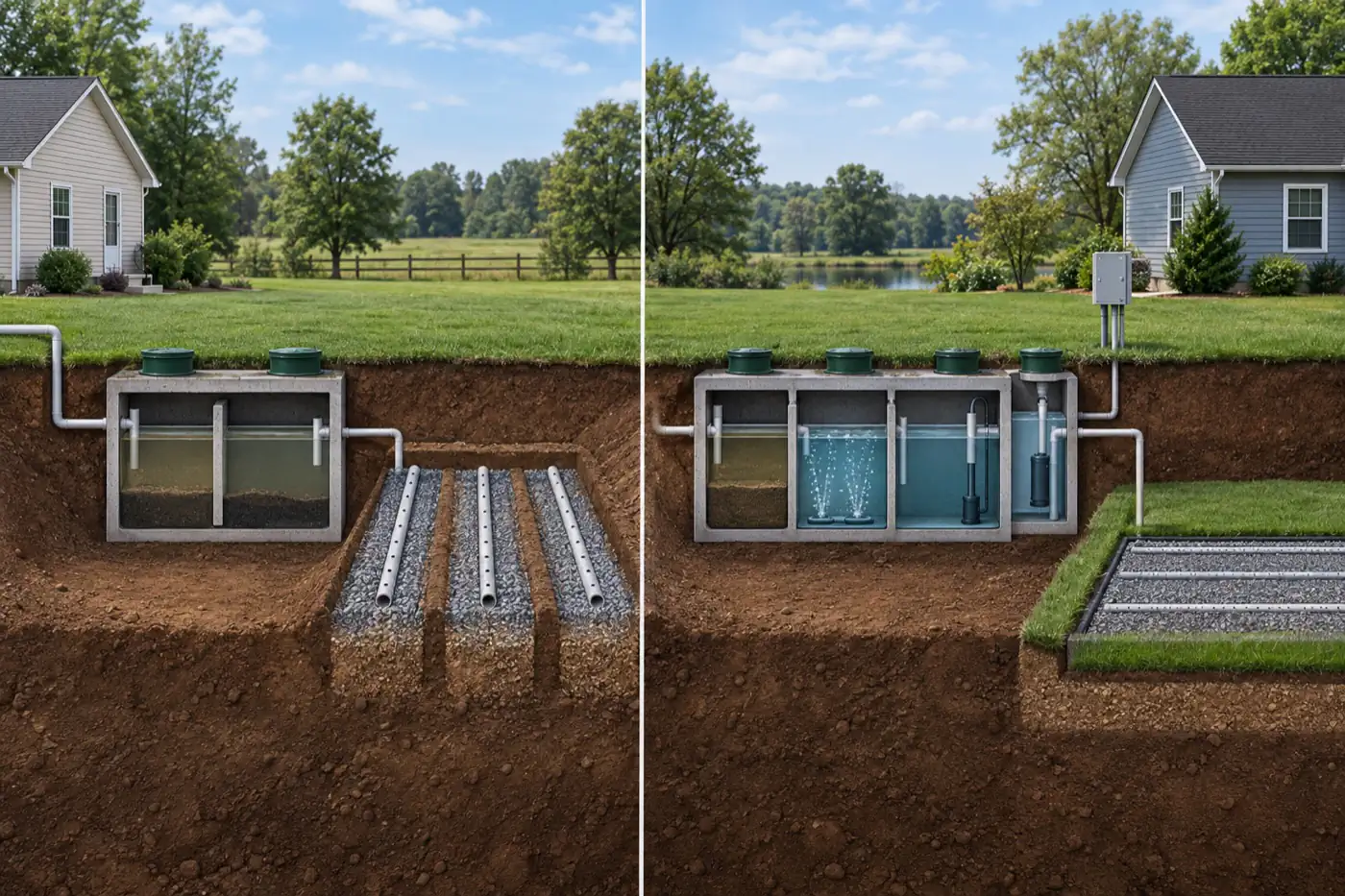
The main difference is where and how treatment occurs. A conventional septic system combines a septic tank with a subsurface drainfield. An aerobic treatment unit adds oxygen to support biological treatment before wastewater reaches the approved downstream treatment or dispersal arrangement.
Neither label tells you the condition, capacity, or total ownership cost of a particular installation. If you are buying a home, compare the actual records and inspection findings. If you are choosing a new system, the site evaluation and local approval determine which options are feasible.
How conventional and aerobic systems differ
EPA explains that a conventional tank retains solids and provides partial treatment; the drainfield and soil provide further treatment and dispersal. An aerobic treatment unit introduces oxygen into the treatment process and may include additional stages such as pretreatment or disinfection. See EPA’s descriptions of septic system types.
Our components guide shows what each part looks like.
“Aerobic” identifies a treatment approach. It does not tell you whether a property’s final dispersal uses spray, drip, or another approved arrangement. Likewise, do not assume every system called conventional operates entirely by gravity: inspect the actual design for pumps and controls.
Comparison at a glance
| Question | Conventional system | Aerobic treatment system |
|---|---|---|
| Where does treatment happen? | In the tank and then the drainfield and soil. | In an oxygen-supported treatment stage, with additional stages depending on the design. |
| What equipment should I identify? | Tank, drainfield, and any installed pumping or distribution equipment. | Treatment unit, aeration equipment, controls, and the downstream arrangement. |
| Does electricity matter? | A gravity layout may have little electrical dependence; pumped layouts differ. | Aeration and any pumps or controls require the specified power supply. |
| What maintenance should I budget for? | Inspection, pumping as needed, and upkeep of installed components. | Those needs plus the service and testing required for the treatment equipment. |
| Is it suitable for this lot? | Must be established through site evaluation and approval. | Must also be established through site evaluation and approval. |
Does aerobic treatment mean you need less land?
Not necessarily for every property. Aerobic treatment can be part of an approved solution for some challenging sites, but the complete installation still needs an appropriate dispersal design. Do not infer a required footprint from the treatment tank alone.
When comparing proposals, request a drawing showing all components, the dispersal area, access requirements, and any required reserve area. Ask which site conditions led the designer to propose that system. A useful comparison explains the design choice rather than simply calling one option “advanced.”
Which system is easier to maintain?
A gravity conventional layout has fewer powered components than a typical aerobic treatment installation. However, fewer components do not mean no maintenance, and an aerobic system’s added equipment is not evidence that it is unreliable.
Ask for the maintenance instructions for the installed model and a written schedule tied to the permit. EPA’s care guidance says the average household system should be inspected at least every three years, while alternative systems with electrical float switches, pumps or mechanical components should generally be inspected once a year, and a service contract is important for them.
For either type, keep reports and resolve recommendations. A home with complete records and no unresolved findings deserves a different assessment from a home where the owner cannot identify the provider or produce inspection documents. Use our maintenance calendar guide to organize recurring responsibilities.
Compare costs using the same scope
A quoted installation price and an annual maintenance fee answer different questions. Comparing one property’s recent repair bill with another property’s basic service fee will not establish which system is cheaper to own.
For an existing home, request actual recent invoices and identify what each covered. Separate routine service, pumping, consumables, electricity, and repairs. For a proposed installation, ask bidders to specify design work, permits, excavation, equipment, electrical work, site restoration, startup, and excluded items.
Then list recurring responsibilities and the basis for each estimate. Ask whether a service price includes testing, reporting, consumables, callouts, and replacement parts. Label uncertain costs as estimates rather than presenting one contractor’s figure as a national average. Our maintenance budgeting guide organizes those categories.
What happens during a power outage?
The answer depends on the powered components and their operating instructions. An aerobic unit needs power for aeration, while a conventional installation may also depend on an effluent pump. A system name is not enough to decide how much water can safely be used during an outage.
Get written instructions from the provider before an outage occurs. Ask about alarm behavior, restrictions on household use, and what to check once power returns. Do not assume a silent panel means the installation is operating normally, and do not improvise generator wiring or alter controls.
Our power outage guide covers the steps.
Questions for someone buying a home
- What is installed? Obtain the permit, design drawing, equipment identification, and approved use.
- What condition is it in? Arrange an appropriate inspection and ask what the inspection covers and excludes.
- What remains unresolved? Request documentation of alarms, recommended work, repairs, and any outstanding authority notices.
- What will ownership involve? Confirm the provider, service requirements, supply responsibilities, and likely recurring cost categories.
- Will my intended use fit? Discuss additional occupants, remodeling, and planned outdoor work before relying on the existing approval.
See our homebuyer inspection checklist for a structured record request. A general home inspection and a specialist septic assessment may cover different things; confirm the scope when booking.
Can you replace one type with the other?
Do not assume a change of treatment technology is a direct equipment swap. Ask a qualified designer and the permitting authority to evaluate the complete system and site. Existing tanks, pipework, electrical supply, and dispersal components may need separate assessment.
Before approving work, request a written explanation of the problem being solved and why the proposed design addresses it. Compare a documented repair option with a documented replacement option where both are feasible. The word “upgrade” alone does not explain the scope or justify the expenditure.
How to make the decision
For a home purchase, prioritize a documented, suitable installation with a clear inspection outcome and manageable ongoing responsibilities. For a new installation, compare the approved options on the same scope and ask the designer to explain site-specific tradeoffs.
An aerobic system is not automatically a reason to reject a house, and a conventional system is not automatically a guarantee of inexpensive ownership. The useful decision comes from the property’s design, condition, records, and service plan.
Sources
- U.S. Environmental Protection Agency, Types of Septic Systems, for the descriptions of both system types and for the aerobic treatment unit as one that injects oxygen into the treatment tank, where the added oxygen increases bacterial activity and provides additional treatment.
- U.S. Environmental Protection Agency, How to Care for Your Septic System, for the regulator’s own distinction between the two: a conventional household system inspected at least every three years and pumped every three to five, against alternative systems with electrical float switches, pumps or mechanical components, which should generally be inspected once a year and for which a service contract is important.
- Texas Commission on Environmental Quality, OSSF maintenance guidance, for the Texas maintenance contract with a licensed provider and the provider’s reports to the permitting authority and owner at least once every four months (30 TAC §285.90(3) is the sample report form); and 30 TAC §285.7, under which, after the initial two-year service policy, the owner of a single-family residence may maintain the system personally instead and is then not subject to the testing and reporting requirements.
- Florida Administrative Code, Rule 62-6.012, for an example of the added obligations an aerobic unit can carry: a current maintenance contract with an approved maintenance entity is a condition of system approval, renewed for the life of the system.
This comparison is general education. It does not establish engineering suitability, permit compliance, or the condition of a particular property.
Last reviewed: October 28, 2026.