
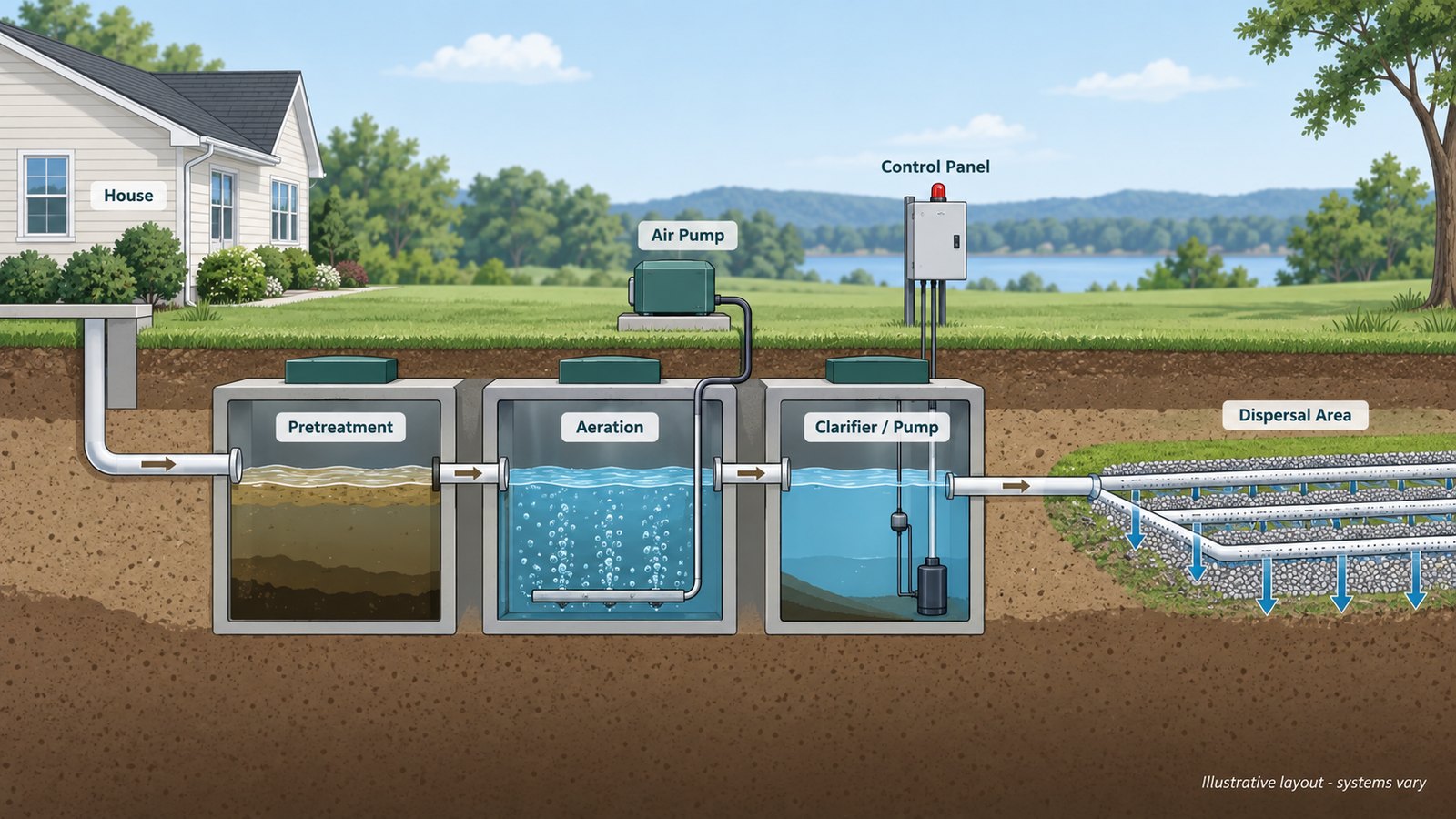
From above ground, an aerobic septic system may look like several access covers, a control panel, and possibly an equipment housing or dispersal fixtures. Most treatment equipment is hidden. The number, color, and arrangement of lids do not reliably identify the system or show whether it is working correctly.
Use the approved drawing and equipment documentation to understand your installation. This guide describes common functions, but not every model uses a separate tank or the same hardware for each function.
Start with the treatment path
A useful conceptual sequence is: household wastewater → initial solids separation where provided → aerobic treatment → solids separation or clarification → any required disinfection → approved dispersal. This is an orientation aid, not a plumbing diagram. Some stages share one structure, and their arrangement varies by design.
EPA’s septic-system overview explains that aerobic units add oxygen to support treatment and may have pretreatment and disinfection stages. Our comparison of how an aerobic system differs from a conventional septic system covers what that means for owners. The downstream dispersal method is a separate part of understanding the complete installation.
Aerobic septic system diagram
The diagram below shows the order in which the parts of a typical aerobic system handle wastewater. It is an illustrative image, not a drawing of your system. EPA describes an aerobic system as one that “injects oxygen into the treatment tank”, and notes that some aerobic systems “may also have a pretreatment tank and a final treatment tank including disinfection.” That is why several stages below are marked “where provided”.
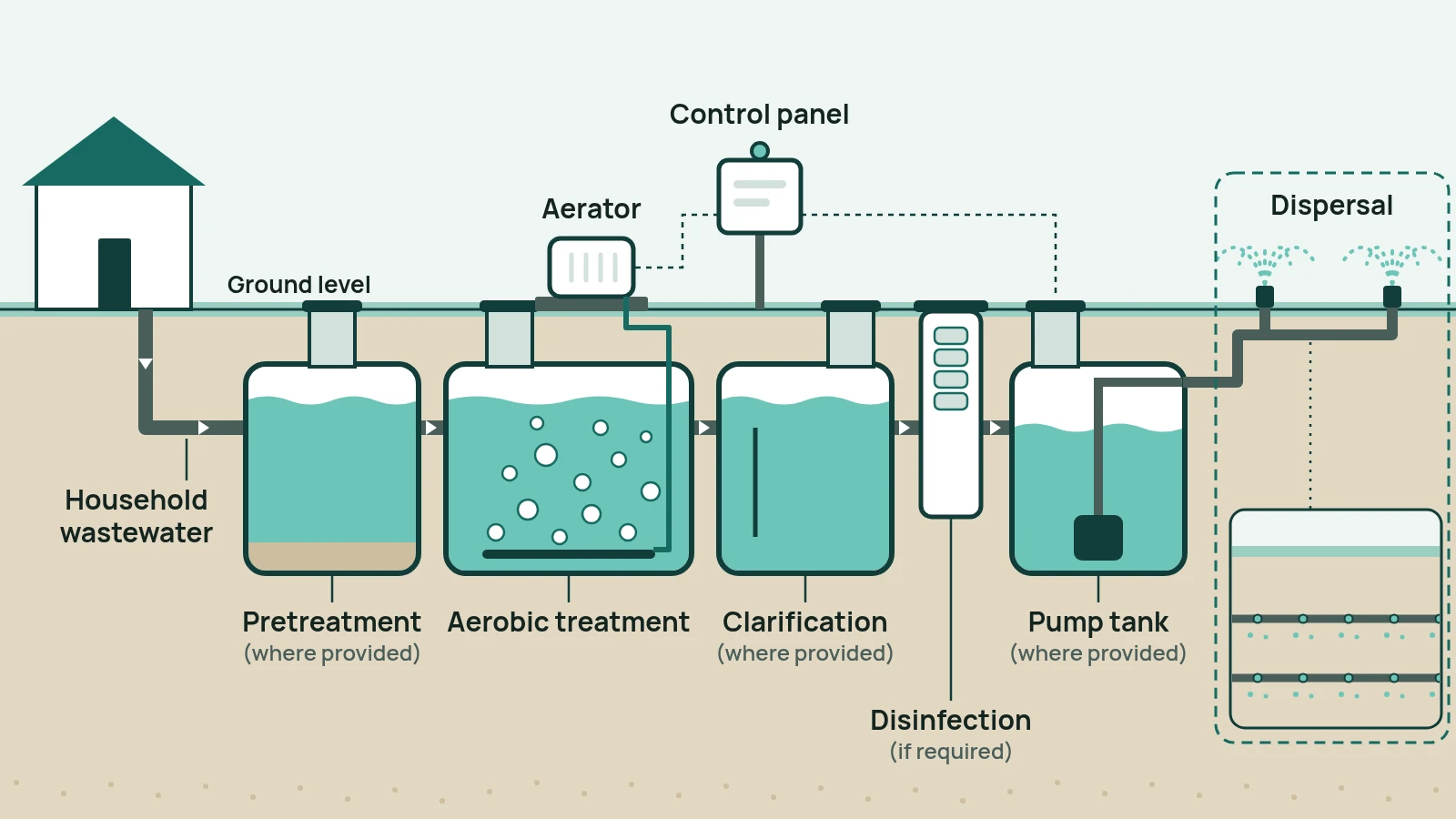
Read it left to right:
- Household wastewater flows from the house to the system.
- Pretreatment (where provided): a tank or compartment for initial solids separation before aeration.
- Aerobic treatment: air is added to the treatment tank by aeration equipment.
- Clarification (where provided): a settling stage after aeration, which may be inside the same treatment structure.
- Disinfection (if required): for example a tablet chlorinator, depending on your design.
- Pump tank (where provided): holds treated effluent before it is sent on.
- Dispersal: the approved method. The diagram shows spray heads with a subsurface inset because not every aerobic unit disperses water through sprinklers.
From above ground you may see only access covers, a control panel and possibly an equipment housing; most treatment equipment is hidden. Your approved drawing and manual show which of these stages your model has and where they are. Do not open any lid to compare it with the diagram.
1. Pretreatment and solids storage
Some installations have a separate pretreatment tank; others incorporate relevant functions into a combined unit. Ask the provider to identify where solids accumulate and which compartments require assessment or pumping under the manufacturer’s instructions.
An access lid is not a label for the function below it. Do not assume the first cover nearest the house is a safe place to add a product or carry out maintenance. Keep covers secured and leave opening them to the appropriate service professional. If lids are buried, septic tank risers can let a provider reach them without digging.
2. Aerobic treatment chamber
This is the part of the treatment process supplied with oxygen. A homeowner’s useful task is to identify the model and understand the expected operation from its documentation, not to inspect the wastewater directly.
Do not assess treatment quality by listening alone or by looking at the yard. The provider’s inspection and any required testing answer different questions from a simple visual observation. Our aerobic septic maintenance guide separates the safe checks you can make between visits from the provider’s work.
3. Aeration equipment
Not every system uses the same aeration mechanism. Some have an external blower or compressor supplying air; other designs use different aeration hardware. A small housing near the tanks may contain relevant equipment, but appearance alone is not enough to identify it.
For a specific example, the Norweco Singulair R3 manual describes its own aerator and control arrangement. It includes timed operation, so its behavior should not be generalized into a rule that every healthy aerator runs continuously.
Record the equipment model from a safely accessible label or service report. Leave covers, wiring, and operating settings alone when you are only trying to identify components.
4. Clarification or solids separation
Where provided, a settling or clarification stage separates material from the liquid after aeration. It may be inside the same treatment structure rather than in a separately visible tank.
Ask your provider how this function is incorporated into the installed model and what its service requirements are. A diagram of another brand can help explain terminology, but it cannot establish the location of parts in your yard.
5. Disinfection equipment, if required
Some installations include a separate disinfection stage. Identify the actual method and equipment before buying supplies. A tablet feeder, a liquid dosing arrangement, and other disinfection equipment have different instructions.
Do not put chemicals into an unidentified pipe or tank opening. Keep a written product specification with the equipment manual. Our chlorine tablet guide explains the questions to ask when a tablet chlorinator is present.
6. Pumping and level controls
Some installations use a pump chamber or other pumping arrangement to move effluent onward. The pump and its level controls may be inaccessible to the homeowner. Ask the provider to identify the component names on the drawing and explain the relevant alarm indications.
The presence of a pump does not establish its capacity, runtime, or operating schedule. Those details come from the design and equipment instructions. Do not test a pump by lifting a float or reaching through an access opening.
7. Control panel and alarms
A panel may display power, operating status, warnings, or a text message. The labels and monitored conditions vary. Photograph the closed panel and readable model information from a safe position, and keep the matching owner’s instructions in your records.
Know which phone number to use when an alarm appears. A silence control is not a repair, and a quiet panel does not prove all treatment functions are normal. See our alarm response guide for the information to record before a service call.
8. Dispersal area
The approved dispersal arrangement could involve subsurface equipment or another locally permitted method. Visible spray fixtures, where present, represent only part of the installation. Do not assume every aerobic unit disperses water through sprinklers.
Obtain the drawing showing the relevant area and any restrictions on its use. Before fencing, landscaping, excavation, or construction, arrange the necessary utility and septic-component locating and obtain appropriate advice or approval. A public utility marking service may not identify privately owned septic components.
Create a component record without opening anything
Copy the following fields into your owner file:
- Property permit or approval reference and drawing date.
- Treatment-unit manufacturer, model, and identification source.
- Aeration-equipment identification, if separately documented.
- Control-panel model and manual location.
- Disinfection method and specified supplies, if applicable.
- Dispersal method and approved area shown on the drawing.
- Provider contact, last report, and next scheduled visit.
Mark unknown entries as “provider to confirm.” An incomplete but accurate record is better than a confident guess. Use our new homeowner checklist to collect the missing documents.
Free: six short email lessons for aerobic septic owners
Lesson 2 gives five entries for your owner log, and Lesson 6 turns your permit, manual and service report into a calendar. One lesson every two days, no cost.
No provider referrals. Unsubscribe in one click.
How to check whether a unit is NSF certified
NSF lists many aerobic treatment unit models under NSF/ANSI Standard 40 (Residential Wastewater Treatment Systems), and some under NSF/ANSI 245 (nitrogen reduction). NSF publishes its certified units online. Your permitting authority decides which certifications are required where you live.
- Find the manufacturer and model on your permit, approved drawing, service report or a label you can read safely. Do not open a lid to look for it.
- Open NSF’s wastewater listings search and choose the standard: NSF/ANSI 40 or NSF/ANSI 245.
- Find the manufacturer, then the model number. Each NSF/ANSI 40 entry shows the model number, a rated capacity in gallons per day, and a classification.
- Compare the model and rated capacity with your permit or drawing. If they don’t match, or the model isn’t listed, ask your provider or permitting authority. Model names can change, and a missing listing doesn’t by itself mean anything is wrong.
- Note the date you checked. NSF says its listings are current as of the date shown on the page and asks users to contact NSF to confirm a listing’s status.
Add the result to your component record.
What appearance cannot tell you
A tidy yard and new covers do not demonstrate treatment performance or permit compliance. Conversely, several visible covers do not automatically mean the system is complicated or defective. Compare the documents, the professional assessment, and the actual equipment.
If you notice an unsecured opening, damaged cover, alarm, suspected wastewater, or exposed wiring, keep clear and contact the appropriate provider promptly. Never enter a septic tank. For a purchase, arrange a defined inspection rather than relying on photographs or a seller’s brief tour.
Page changes: October 15, 2026: Added an illustrative labeled diagram of the treatment path, with a text explanation. Added “How to check whether a unit is NSF certified” (NSF public listings). Added 1 source (NSF listings). No existing claim changed.
Sources
- U.S. Environmental Protection Agency, Types of Septic Systems, for the description of an aerobic treatment unit as a system that injects oxygen into the treatment tank, where the added oxygen increases bacterial activity and provides additional treatment.
- Oklahoma Administrative Code, OAC 252:641-10-3, for a rule that names the components individually and what is measured in each: the trash tank and its sludge depth, the sludge volume in forced-air aerobic treatment units, the pump tank and its clarity test, and the free chlorine residual of the effluent where spray dispersal is used.
- U.S. Environmental Protection Agency, How to Care for Your Septic System, for the distinction between a conventional system and one with electrical float switches, pumps and mechanical components, which is what separates the parts that wear out from the parts that do not.
- Texas A&M AgriLife Extension, B-6234, “Living with an Aerobic Treatment Unit and Spray Field”, for the spray field and for the hazards attached to each component an owner might be tempted to open.
This guide explains component names and record keeping. It is not an installation plan, inspection report, or permission to open or service equipment.