
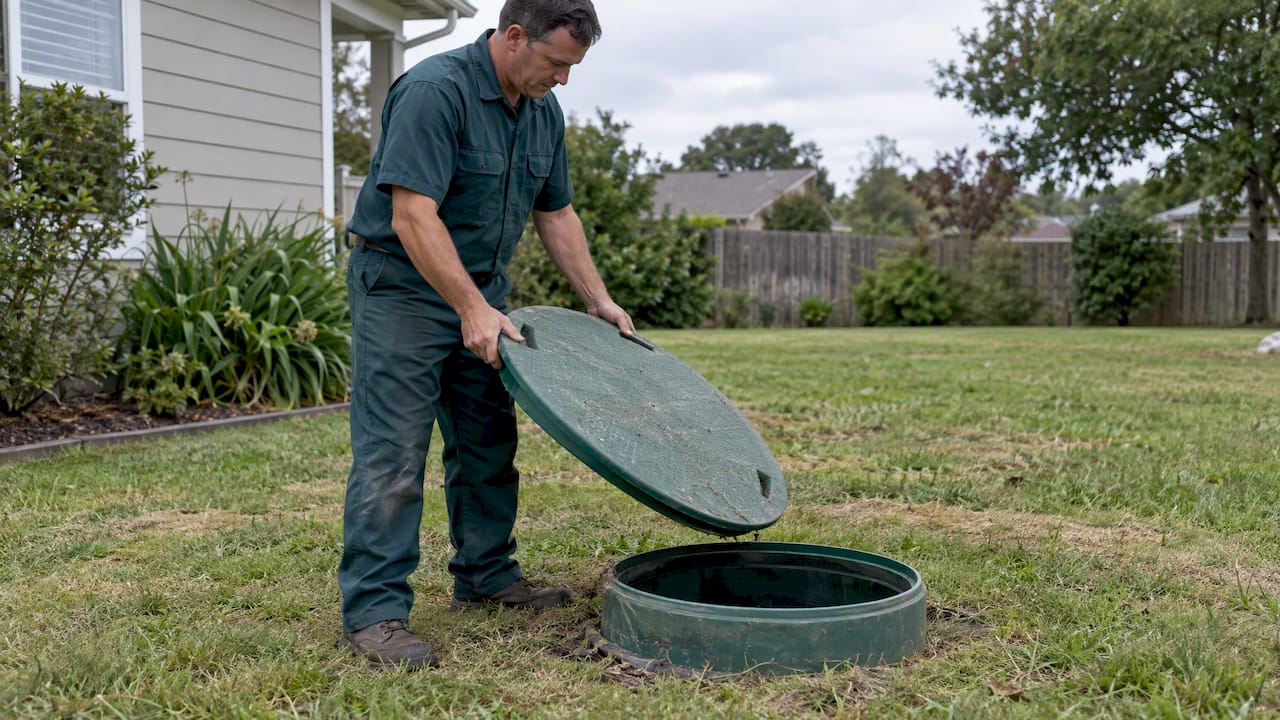
A septic tank riser is a watertight pipe that brings a tank opening up to ground level, so the lid can be reached without digging. On an aerobic system, that makes the visits required by your permit and manual easier to carry out. Risers do not change how often service happens. Check permit and access rules with your local authority first.
Table of Contents
- What septic tank risers do and why they matter
- Materials, sizes, and lid options
- Benefits, pros and cons, and when not to install a riser
- Installing a septic tank riser: steps, permits, and safety
- Maintenance and inspection: how risers change your service routine
- Riser height, concrete lids, and cost: what homeowners actually ask
- Why risers matter even more for aerobic (ATU) systems
- Riser checklist between service visits
- Track your riser inspections with our free checklist
- FAQ
- Sources
What septic tank risers do and why they matter
A riser’s job is simple: it extends the access opening on your tank from several inches or feet underground up to the surface, so the lid sits flush with the lawn instead of buried under soil. Newer septic tanks generally include risers for exactly this reason, since they let a technician find, open, and service the tank without digging first, according to EPA homeowner guidance.
Risers are not the same as random inspection ports. Proper access needs to sit directly over the inlet and outlet tees or baffles, the parts that control flow in and out of the tank and that inspectors check most closely.
- Risers eliminate repeated excavation for every pumping or inspection visit.
- Access placed over inlet and outlet baffles lets technicians check for clogs or damage quickly.
Materials, sizes, and lid options
Risers come in a few common materials, each with trade-offs. Polyethylene (HDPE) risers are lightweight, resist cracking, and are the most common choice for new installations and retrofits. Fiberglass risers offer similar durability with a more rigid wall. Concrete risers match older concrete tanks structurally but weigh much more and are harder to install without equipment.
Diameter depends on the opening you are covering: smaller ports over baffles are often fine at a narrower width, while the main tank access typically calls for a larger, manhole-style riser that allows a technician to reach in with pumping equipment.
- HDPE and fiberglass: lighter materials; suitability and installation details depend on the approved tank and riser system.
- Concrete: heavier, often chosen to match existing concrete tank lids.
- Lids: choose sealed, lockable, watertight covers, with traffic-rated versions available for risers near driveways or parking areas.
Benefits, pros and cons, and when not to install a riser
Risers make routine service easier, but they are not automatically the right move for every yard. Here is a balanced look.
- Benefit: the provider can reach the opening without digging at each visit.
- Benefit: emergency access becomes much faster when an alarm goes off or a backup starts.
- Benefit: some permitting authorities require risers on new installations, so check local rules before you sell or upgrade a system.
- Drawback: upfront material and labor cost, plus the risk of a poorly sealed riser pulling away from an older concrete tank and letting groundwater in.
- Drawback: a riser placed in a high-traffic area, like a driveway or play space, needs a reinforced, traffic-rated lid or should be relocated if possible.
Some situations call for extra care rather than skipping the riser altogether: tanks under pavement, tanks with deteriorated concrete rims, or systems where local code restricts above-grade fixtures near a property line.
Installing a septic tank riser: steps, permits and safety
Have a qualified installer identify the approved access points, tank condition, compatible riser and lid, sealing method and required height. Confirm permits and inspections with your local authority before any excavation. Do not plug baffles, improvise a seal or modify tank access based on a general article.
Keep vehicles away from tanks unless the complete installation is designed and approved for that load; a traffic-rated lid alone does not make a tank safe to drive over. Never enter a tank or lean into an opening. Keep children and pets away and all covers secured.
Clallam County’s access-riser guidance is a local example, not a national installation specification.
Maintenance and inspection: how risers change your service routine
Once a riser is in place, your pumping and inspection schedule gets easier to keep on track rather than easier to skip. Lids, risers, and access ports should stay watertight and secured, with inspection access maintained directly over the inlet and outlet tees, according to the Missouri Department of Health’s system owner’s manual.
- Technicians can check sludge and scum levels without excavation, which keeps pump-outs on schedule instead of delayed.
- Risers give technicians access to the treatment compartments at the service intervals required by your permit and manufacturer.
- A failed seal or a cracked lid lets groundwater into the tank, which can overload the system and trigger backups.
If you notice standing water pooling around a riser lid, or the lid no longer sits flush, treat it as a possible drainage or seal problem and call for a repair before your next scheduled service. Our aerobic system maintenance schedule helps organize observations and the professional service dates required for your system.
Riser height, concrete lids, and cost: what homeowners actually ask
A few practical questions come up constantly once homeowners understand what a riser does.
- Riser height should bring the lid to grade level without creating a tripping hazard or a large mound; most installations aim for a flush or slightly raised fit rather than a tall stack of extensions.
- A riser does not have to replace an existing concrete manhole lid. It is often added on top of or around the existing opening, so the original tank structure stays intact while access moves to the surface.
- Cost: Angi puts a typical septic tank riser at about $200 to $400 installed, and roughly double that for two risers (Angi, updated December 2021). Treat that as a rough national figure: depth, lid material, the number of openings and local labor rates move the price, and some areas also charge a permit fee. For budgeting help, see our maintenance cost breakdown, or ask a local pumping company or your county permit office for a quote based on your tank and site conditions.
Why risers matter even more for aerobic (ATU) systems
Accessible, approved openings let providers perform the work required for your equipment without repeated excavation. Inspection frequency depends on local rules and the permit. For example, Texas guidance describes four-month reporting with a conditional six-month exception for some monitored systems. Do not assume every ATU needs only two visits per year.
Ask your provider which compartments need access and consult our components guide.
What to ask your provider
- Which openings do you need to reach on my system, and are they accessible now?
- Is a riser or a different lid approved for my tank, and does it need a permit?
- Is the lid secured to the standard you expect?
- Does my maintenance contract cover riser or lid repairs?
- How often does my permit require visits and reports?
Riser checklist between service visits
From the surface, without opening anything:
- Lids are in place, secured and sitting flush.
- There is no standing water around a lid after rain.
- No cracks, gaps or settling show around the riser.
- Nothing (vehicles, new soil, structures) sits over the access.
- If something looks wrong, write down the date, take a photo from a safe distance and tell your provider.
Track your riser inspections with our free checklist
A riser only pays off if you actually use the access it gives you, which is where a simple tracking habit helps more than any product upgrade. Use a maintenance record to track observations and the service dates set by your permit, manufacturer and provider.
- Track the inspection and reporting dates required for your specific system.
- Log alarm tests and compressor checks alongside your service reports.
- Keep a paper trail your county health department may ask to see at resale or permit renewal.
Keep a record of every service visit, alarm and repair. Download the free Aerobic Septic Maintenance Record (PDF).
FAQ
Are septic tank risers a good idea?
For many tanks, yes. A riser lets a provider reach the opening without digging. For aerobic systems, approved access supports the service your permit and manufacturer require. Ask your provider and permitting office whether a riser is approved for your tank.
How much does it cost to put risers on a septic tank?
We are not able to cite a reliable cost figure here because none of the primary sources used in this guide publish current pricing. For an estimate based on your tank size and site, check our maintenance cost guide or contact a local septic service provider.
How high can a septic tank riser be?
A riser should generally extend to grade level so the lid sits flush or very slightly above the surrounding soil, avoiding a tall, unstable stack of extensions. The exact allowable height depends on your tank depth and local code, so check with your county health department before finalizing the installation.
Does a septic tank riser replace a concrete lid?
The approved retrofit design determines which existing cover is retained or replaced. Ask the installer to explain the compatible adapter, cover and secured access arrangement; do not assume an old concrete lid should remain beneath every riser.
What are the main safety risks with septic tank risers?
Septic tanks produce sewer gases that are toxic and potentially flammable, and the tank interior is a confined space that should never be entered. Unsecured or damaged riser lids also create a serious fall and entrapment hazard for children, pets, and anyone mowing nearby, so every lid should stay locked and watertight.
Sources
- An Onsite Wastewater Treatment System Owner’s Manual (Missouri Department of Health)
- Homeowner’s Guide to Septic Systems (EPA)
- Aerobic Treatment Unit operations and maintenance program FAQ (Brevard/Monroe County health)
- What Is a Septic Tank Riser? (Angi)
- Installing Access Risers (Clallam County, WA)
- Maintenance of On-Site Sewage Facilities (TCEQ)